模型训练中防止过拟合的十大实用方案

模型训练中防止过拟合的十大实用方案

贺公子之数据科学与艺术
发布于 2026-06-18 11:00:57
发布于 2026-06-18 11:00:57
1. 什么是过拟合?
过拟合(Overfitting)是机器学习模型训练过程中常见的问题,指模型在训练数据上表现优异,但在未见过的测试数据上表现不佳的现象。简单来说,模型“记住了”训练数据的细节和噪声,而不是学习到数据背后的通用规律。
过拟合的典型表现:
- 训练集准确率很高(接近100%)
- 验证集/测试集准确率明显下降
- 模型对训练数据中的噪声过度敏感
- 模型复杂度远高于问题本身所需
2. 数据层面的解决方案
2.1 增加训练数据量
数据是机器学习的基础,更多的数据意味着模型能学习到更全面的模式。
实践建议:
- 收集更多真实数据
- 使用数据增强技术(特别是计算机视觉任务)
- 考虑迁移学习,利用预训练模型
2.2 数据增强(Data Augmentation)
通过对现有数据进行变换,生成新的训练样本。
常见的数据增强方法:
- 图像数据:旋转、翻转、缩放、裁剪、颜色变换
- 文本数据:同义词替换、随机删除、回译
- 音频数据:添加噪声、变速、变调
# 图像数据增强示例(使用albumentations库)
import albumentations as A

transform = A.Compose([
    A.RandomRotate90(),
    A.Flip(),
    A.Transpose(),
    A.RandomBrightnessContrast(p=0.5),
    A.RandomGamma(p=0.5),
])
2.3 特征选择与降维
移除冗余或不相关的特征,降低模型复杂度。
常用方法:
- 主成分分析(PCA)
- 线性判别分析(LDA)
- 基于树模型的特征重要性评估
- 递归特征消除(RFE)
3. 模型层面的解决方案
3.1 正则化技术
正则化通过在损失函数中添加惩罚项,限制模型参数的大小。
L1正则化(Lasso)
- 惩罚项:λ∑|w|
- 特点:会产生稀疏解,可用于特征选择
L2正则化(Ridge)
- 惩罚项:λ∑w²
- 特点:使权重趋于较小值,但不为零
Elastic Net
- 结合L1和L2正则化
- 公式:λ₁∑|w| + λ₂∑w²
# TensorFlow/Keras中的正则化示例
from tensorflow.keras import regularizers

model = tf.keras.Sequential([
    tf.keras.layers.Dense(64,
                         kernel_regularizer=regularizers.l2(0.01),
                         activity_regularizer=regularizers.l1(0.01)),
    tf.keras.layers.Dense(10)
])
3.2 Dropout
在训练过程中随机“丢弃”一部分神经元,防止神经元之间过度依赖。
Dropout的优势:
- 相当于训练多个不同的子网络
- 提高模型的泛化能力
- 实现简单,效果显著
# Dropout层使用示例
model = tf.keras.Sequential([
    tf.keras.layers.Dense(128, activation='relu'),
    tf.keras.layers.Dropout(0.5),  # 丢弃50%的神经元
    tf.keras.layers.Dense(64, activation='relu'),
    tf.keras.layers.Dropout(0.3),  # 丢弃30%的神经元
    tf.keras.layers.Dense(10, activation='softmax')
])
3.3 早停法(Early Stopping)
监控验证集性能,当性能不再提升时停止训练。
实现要点:
- 设置合理的耐心值(patience)
- 保存最佳模型权重
- 结合学习率调度使用效果更佳
# Early Stopping回调示例
from tensorflow.keras.callbacks import EarlyStopping

early_stopping = EarlyStopping(
    monitor='val_loss',
    patience=10,          # 连续10个epoch验证损失不改善则停止
    restore_best_weights=True,  # 恢复最佳权重
    verbose=1
)

model.fit(X_train, y_train,
          validation_data=(X_val, y_val),
          epochs=100,
          callbacks=[early_stopping])
3.4 批量归一化(Batch Normalization)
对每一层的输入进行归一化处理,加速训练并提高泛化能力。
BN层的作用:
- 减少内部协变量偏移
- 允许使用更高的学习率
- 有一定的正则化效果
4. 训练策略层面的解决方案
4.1 交叉验证(Cross-Validation)
将数据集分成多个子集,轮流作为验证集。
常用方法:
- K折交叉验证(K-Fold CV)
- 留一法交叉验证(Leave-One-Out)
- 分层K折交叉验证(Stratified K-Fold)
# 5折交叉验证示例
from sklearn.model_selection import cross_val_score
from sklearn.ensemble import RandomForestClassifier

model = RandomForestClassifier(n_estimators=100)
scores = cross_val_score(model, X, y, cv=5, scoring='accuracy')
print(f"交叉验证准确率: {scores.mean():.3f} (±{scores.std():.3f})")
4.2 集成学习(Ensemble Learning)
结合多个模型的预测结果,降低过拟合风险。
常用集成方法:
- Bagging:并行训练多个模型,投票或平均
- Boosting:顺序训练,关注前序模型的错误
- Stacking:用元模型组合多个基模型的预测
4.3 学习率调度
动态调整学习率,帮助模型跳出局部最优。
常用调度策略:
- 指数衰减
- 余弦退火
- ReduceLROnPlateau(在平台期降低学习率)
5. 模型架构层面的解决方案
5.1 简化模型复杂度
- 减少网络层数
- 减少每层的神经元数量
- 使用更简单的模型架构
5.2 权重约束
限制权重的最大值,防止权重过大。
# 权重约束示例
from tensorflow.keras.constraints import max_norm

model.add(Dense(64,
                kernel_constraint=max_norm(3.0),  # 限制权重最大范数为3
                activation='relu'))
6. 评估与监控
6.1 学习曲线分析
通过绘制训练和验证损失曲线,直观判断过拟合。
过拟合的典型学习曲线:
- 训练损失持续下降
- 验证损失先降后升(出现"U"形)
- 训练和验证损失差距逐渐增大
6.2 混淆矩阵与分类报告
深入分析模型在各类别上的表现。
6.3 特征重要性分析
理解模型依赖哪些特征做决策。
7. 实践建议与组合策略
7.1 针对不同场景的推荐方案
以下是过拟合解决方案的选择流程图,描述了从数据检查、模型选择到策略组合的完整决策路径:
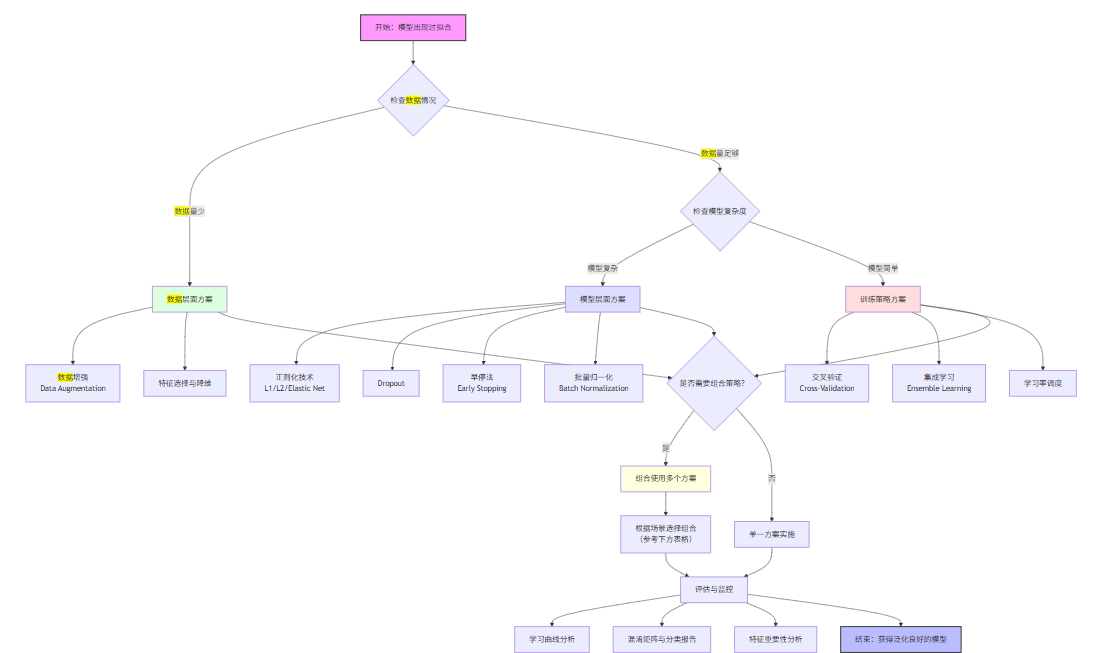
场景类型 | 推荐方案 | 理由 |
|---|---|---|
小样本数据 | 数据增强 + Dropout + 早停法 | 弥补数据不足,防止过拟合 |
高维特征 | L1正则化 + 特征选择 | 减少特征维度,提高泛化 |
深度神经网络 | Dropout + BN层 + 权重衰减 | 综合应对深度网络过拟合 |
传统机器学习 | 交叉验证 + 集成学习 | 稳定评估,提高泛化 |
7.2 组合使用多个方案
在实际项目中,通常需要组合使用多种技术:
# 综合防过拟合策略示例
def create_robust_model(input_shape, num_classes):
    model = tf.keras.Sequential([
        # 输入层
        tf.keras.layers.Input(shape=input_shape),

        # 第一层:Dense + BN + Dropout
        tf.keras.layers.Dense(256,
                             kernel_regularizer=tf.keras.regularizers.l2(0.01)),
        tf.keras.layers.BatchNormalization(),
        tf.keras.layers.Activation('relu'),
        tf.keras.layers.Dropout(0.3),

        # 第二层
        tf.keras.layers.Dense(128,
                             kernel_regularizer=tf.keras.regularizers.l2(0.01)),
        tf.keras.layers.BatchNormalization(),
        tf.keras.layers.Activation('relu'),
        tf.keras.layers.Dropout(0.3),

        # 输出层
        tf.keras.layers.Dense(num_classes, activation='softmax')
    ])

    return model

# 训练配置
callbacks = [
    tf.keras.callbacks.EarlyStopping(patience=10, restore_best_weights=True),
    tf.keras.callbacks.ReduceLROnPlateau(factor=0.5, patience=5)
]
下面是一个完整的端到端实战示例,包含数据生成、模型构建、训练、评估和过拟合对比:
import numpy as np
import matplotlib.pyplot as plt
import tensorflow as tf
from sklearn.datasets import make_classification
from sklearn.model_selection import train_test_split
from sklearn.preprocessing import StandardScaler

# 1. 数据加载与预处理
print("1. 生成模拟数据...")
X, y = make_classification(
    n_samples=5000,          # 总样本数
    n_features=20,           # 特征数
    n_informative=15,        # 有效特征数
    n_redundant=5,           # 冗余特征数
    n_classes=3,             # 类别数
    n_clusters_per_class=2,  # 每类簇数
    random_state=42
)

# 划分训练集、验证集、测试集
X_train, X_temp, y_train, y_temp = train_test_split(X, y, test_size=0.3, random_state=42)
X_val, X_test, y_val, y_test = train_test_split(X_temp, y_temp, test_size=0.5, random_state=42)

# 标准化
scaler = StandardScaler()
X_train = scaler.fit_transform(X_train)
X_val = scaler.transform(X_val)
X_test = scaler.transform(X_test)

print(f"训练集: {X_train.shape}, 验证集: {X_val.shape}, 测试集: {X_test.shape}")

# 2. 模型构建函数(复用前面的 create_robust_model)
def create_robust_model(input_shape, num_classes):
    model = tf.keras.Sequential([
        tf.keras.layers.Input(shape=input_shape),

        # 第一层:Dense + L2正则化 + BN + Dropout
        tf.keras.layers.Dense(256,
                             kernel_regularizer=tf.keras.regularizers.l2(0.01)),
        tf.keras.layers.BatchNormalization(),
        tf.keras.layers.Activation('relu'),
        tf.keras.layers.Dropout(0.3),

        # 第二层
        tf.keras.layers.Dense(128,
                             kernel_regularizer=tf.keras.regularizers.l2(0.01)),
        tf.keras.layers.BatchNormalization(),
        tf.keras.layers.Activation('relu'),
        tf.keras.layers.Dropout(0.3),

        # 输出层
        tf.keras.layers.Dense(num_classes, activation='softmax')
    ])
    return model

# 3. 创建并编译稳健模型
print("\n2. 构建稳健模型...")
robust_model = create_robust_model(input_shape=(20,), num_classes=3)
robust_model.compile(
    optimizer=tf.keras.optimizers.Adam(learning_rate=0.001),
    loss='sparse_categorical_crossentropy',
    metrics=['accuracy']
)
robust_model.summary()

# 4. 训练配置(早停 + 学习率调度)
callbacks = [
    tf.keras.callbacks.EarlyStopping(
        monitor='val_loss',
        patience=10,
        restore_best_weights=True,
        verbose=1
    ),
    tf.keras.callbacks.ReduceLROnPlateau(
        monitor='val_loss',
        factor=0.5,
        patience=5,
        min_lr=1e-6,
        verbose=1
    ),
    tf.keras.callbacks.ModelCheckpoint(
        'best_robust_model.h5',
        monitor='val_accuracy',
        save_best_only=True,
        verbose=1
    )
]

# 5. 训练稳健模型
print("\n3. 训练稳健模型...")
history_robust = robust_model.fit(
    X_train, y_train,
    validation_data=(X_val, y_val),
    epochs=100,
    batch_size=32,
    callbacks=callbacks,
    verbose=1
)

# 6. 创建过拟合对比模型(无正则化、无Dropout、复杂结构)
print("\n4. 构建过拟合对比模型...")
overfit_model = tf.keras.Sequential([
    tf.keras.layers.Input(shape=(20,)),
    tf.keras.layers.Dense(512, activation='relu'),
    tf.keras.layers.Dense(512, activation='relu'),
    tf.keras.layers.Dense(256, activation='relu'),
    tf.keras.layers.Dense(128, activation='relu'),
    tf.keras.layers.Dense(64, activation='relu'),
    tf.keras.layers.Dense(3, activation='softmax')
])

overfit_model.compile(
    optimizer=tf.keras.optimizers.Adam(learning_rate=0.01),  # 高学习率
    loss='sparse_categorical_crossentropy',
    metrics=['accuracy']
)

# 7. 训练过拟合模型(无早停,小批量)
print("\n5. 训练过拟合模型...")
history_overfit = overfit_model.fit(
    X_train, y_train,
    validation_data=(X_val, y_val),
    epochs=150,  # 更多轮次
    batch_size=8,  # 更小批量,更容易过拟合
    verbose=1
)

# 8. 评估两个模型
print("\n6. 模型评估...")

# 稳健模型评估
robust_train_loss, robust_train_acc = robust_model.evaluate(X_train, y_train, verbose=0)
robust_val_loss, robust_val_acc = robust_model.evaluate(X_val, y_val, verbose=0)
robust_test_loss, robust_test_acc = robust_model.evaluate(X_test, y_test, verbose=0)

print(f"\n稳健模型结果:")
print(f"训练集 - 损失: {robust_train_loss:.4f}, 准确率: {robust_train_acc:.4f}")
print(f"验证集 - 损失: {robust_val_loss:.4f}, 准确率: {robust_val_acc:.4f}")
print(f"测试集 - 损失: {robust_test_loss:.4f}, 准确率: {robust_test_acc:.4f}")

# 过拟合模型评估
overfit_train_loss, overfit_train_acc = overfit_model.evaluate(X_train, y_train, verbose=0)
overfit_val_loss, overfit_val_acc = overfit_model.evaluate(X_val, y_val, verbose=0)
overfit_test_loss, overfit_test_acc = overfit_model.evaluate(X_test, y_test, verbose=0)

print(f"\n过拟合模型结果:")
print(f"训练集 - 损失: {overfit_train_loss:.4f}, 准确率: {overfit_train_acc:.4f}")
print(f"验证集 - 损失: {overfit_val_loss:.4f}, 准确率: {overfit_val_acc:.4f}")
print(f"测试集 - 损失: {overfit_test_loss:.4f}, 准确率: {overfit_test_acc:.4f}")

# 9. 可视化对比
fig, axes = plt.subplots(2, 2, figsize=(14, 10))

# 训练/验证准确率对比
axes[0, 0].plot(history_robust.history['accuracy'], label='稳健模型-训练', color='blue', linestyle='-')
axes[0, 0].plot(history_robust.history['val_accuracy'], label='稳健模型-验证', color='blue', linestyle='--')
axes[0, 0].plot(history_overfit.history['accuracy'], label='过拟合模型-训练', color='red', linestyle='-')
axes[0, 0].plot(history_overfit.history['val_accuracy'], label='过拟合模型-验证', color='red', linestyle='--')
axes[0, 0].set_xlabel('Epoch')
axes[0, 0].set_ylabel('Accuracy')
axes[0, 0].set_title('训练集 vs 验证集准确率对比')
axes[0, 0].legend()
axes[0, 0].grid(True, alpha=0.3)

# 训练/验证损失对比
axes[0, 1].plot(history_robust.history['loss'], label='稳健模型-训练', color='blue', linestyle='-')
axes[0, 1].plot(history_robust.history['val_loss'], label='稳健模型-验证', color='blue', linestyle='--')
axes[0, 1].plot(history_overfit.history['loss'], label='过拟合模型-训练', color='red', linestyle='-')
axes[0, 1].plot(history_overfit.history['val_loss'], label='过拟合模型-验证', color='red', linestyle='--')
axes[0, 1].set_xlabel('Epoch')
axes[0, 1].set_ylabel('Loss')
axes[0, 1].set_title('训练集 vs 验证集损失对比')
axes[0, 1].legend()
axes[0, 1].grid(True, alpha=0.3)

# 泛化差距可视化
epochs_robust = len(history_robust.history['accuracy'])
epochs_overfit = len(history_overfit.history['accuracy'])

robust_gap = np.array(history_robust.history['accuracy']) - np.array(history_robust.history['val_accuracy'])
overfit_gap = np.array(history_overfit.history['accuracy']) - np.array(history_overfit.history['val_accuracy'])

axes[1, 0].plot(range(epochs_robust), robust_gap, label='稳健模型', color='blue', linewidth=2)
axes[1, 0].plot(range(epochs_overfit), overfit_gap, label='过拟合模型', color='red', linewidth=2)
axes[1, 0].axhline(y=0, color='gray', linestyle='--', alpha=0.5)
axes[1, 0].set_xlabel('Epoch')
axes[1, 0].set_ylabel('训练-验证准确率差距')
axes[1, 0].set_title('泛化差距对比(越小越好)')
axes[1, 0].legend()
axes[1, 0].grid(True, alpha=0.3)

# 最终性能对比
models = ['稳健模型', '过拟合模型']
train_accs = [robust_train_acc, overfit_train_acc]
val_accs = [robust_val_acc, overfit_val_acc]
test_accs = [robust_test_acc, overfit_test_acc]

x = np.arange(len(models))
width = 0.25

axes[1, 1].bar(x - width, train_accs, width, label='训练集', color='lightblue', edgecolor='black')
axes[1, 1].bar(x, val_accs, width, label='验证集', color='lightgreen', edgecolor='black')
axes[1, 1].bar(x + width, test_accs, width, label='测试集', color='lightcoral', edgecolor='black')

axes[1, 1].set_xlabel('模型')
axes[1, 1].set_ylabel('准确率')
axes[1, 1].set_title('最终性能对比')
axes[1, 1].set_xticks(x)
axes[1, 1].set_xticklabels(models)
axes[1, 1].legend()
axes[1, 1].grid(True, alpha=0.3, axis='y')

plt.tight_layout()
plt.savefig('overfitting_comparison.png', dpi=300, bbox_inches='tight')
plt.show()

print("\n7. 分析总结:")
print("-" * 50)
print("稳健模型特点:")
print("1. 使用L2正则化、Dropout、BatchNorm等防过拟合技术")
print("2. 配合早停法和学习率调度")
print("3. 训练集和验证集性能接近,泛化差距小")
print("4. 在测试集上表现稳定")

print("\n过拟合模型特点:")
print("1. 网络层数多、神经元多,无正则化")
print("2. 使用高学习率、小批量")
print("3. 训练集准确率高但验证集/测试集差")
print("4. 明显的训练-验证性能差距")

print("\n关键观察:")
print(f"• 稳健模型泛化差距: {robust_gap[-1]:.4f}")
print(f"• 过拟合模型泛化差距: {overfit_gap[-1]:.4f}")
print(f"• 稳健模型在测试集上比过拟合模型高 {100*(robust_test_acc - overfit_test_acc):.2f}%")
运行说明:
- 确保已安装所需库:
pip install tensorflow scikit-learn matplotlib numpy - 代码可直接复制运行,生成模拟数据、训练两个对比模型
- 运行后会保存最佳模型 (
best_robust_model.h5) 和对比图 (overfitting_comparison.png) - 通过4个子图直观展示过拟合现象和防过拟合技术的效果
这个完整示例展示了从数据生成到模型评估的全流程,通过对比实验清晰地说明了组合使用多种防过拟合技术的实际效果。
8. 总结
防止过拟合是机器学习模型训练中的核心任务。通过本文介绍的十大方案,您可以根据具体场景选择合适的策略:
- 数据层面:增加数据、数据增强、特征选择
- 模型层面:正则化、Dropout、早停法、批量归一化
- 训练策略:交叉验证、集成学习、学习率调度
- 模型架构:简化复杂度、权重约束
最佳实践建议:
- 从简单模型开始,逐步增加复杂度
- 始终使用验证集监控模型性能
- 组合使用多种防过拟合技术
- 理解每种技术的原理和适用场景
记住,没有一种方案是万能的。在实际项目中,需要根据数据特点、问题类型和计算资源,灵活选择和组合这些方案,才能训练出既准确又泛化能力强的模型。
本文参与 腾讯云自媒体同步曝光计划,分享自作者个人站点/博客。
原始发表:2026-06-17,如有侵权请联系 cloudcommunity@tencent.com 删除
目录
腾讯云开发者

Copyright © 2013 - 2026 Tencent Cloud. All Rights Reserved. 腾讯云 版权所有
深圳市腾讯计算机系统有限公司 ICP备案/许可证号:粤B2-20090059  粤公网安备44030502008569号
腾讯云计算(北京)有限责任公司 京ICP证150476号 | 京ICP备11018762号