权限与安全系统

权限与安全系统

架构师部落
发布于 2026-06-22 13:36:50
发布于 2026-06-22 13:36:50
第5篇:权限与安全系统
构建安全可控的AI权限系统
AI系统的安全性是企业级应用的核心关注点。Claude Code 的权限系统采用多层次、可配置的设计,既保证了灵活性又确保了安全性。本篇将深入剖析其实现细节。
1. 权限系统架构概览
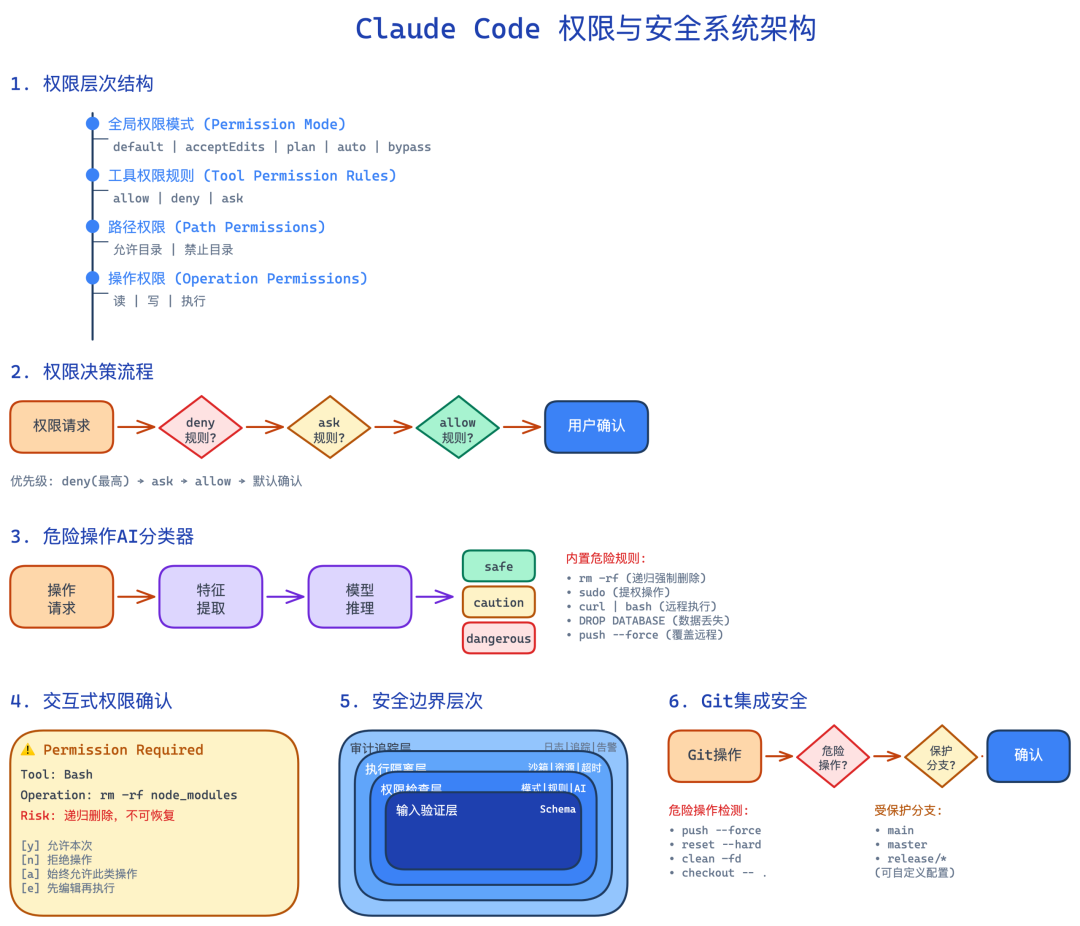
1.1 设计哲学
Claude Code 的权限系统围绕以下核心原则设计:
原则 | 描述 | 实现方式 |
|---|---|---|
默认拒绝 | 未明确允许的操作默认拒绝 | 白名单机制 |
最小权限 | 只授予必要的最小权限 | 精细规则匹配 |
分级控制 | 不同操作需要不同级别的确认 | 权限模式系统 |
可审计 | 所有权限决策可追溯 | 审计日志 |
可覆盖 | 支持企业策略强制覆盖 | Policy优先级 |
1.2 权限层次结构
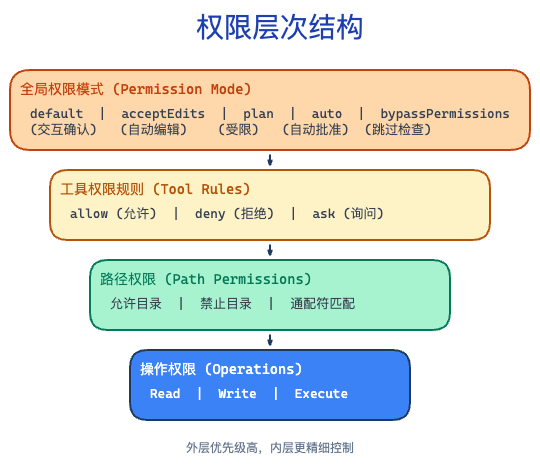
权限层次
├── 全局权限模式 (Permission Mode)
│   ├── default - 交互式确认
│   ├── acceptEdits - 自动接受编辑
│   ├── plan - 计划模式(受限)
│   ├── auto - 自动批准
│   └── bypassPermissions - 跳过所有检查
│
├── 工具权限规则 (Tool Permission Rules)
│   ├── allow - 允许规则
│   ├── deny - 拒绝规则
│   └── ask - 需要确认
│
├── 路径权限 (Path Permissions)
│   ├── 允许的目录
│   └── 禁止的目录
│
└── 操作权限 (Operation Permissions)
    ├── 读操作
    ├── 写操作
    └── 执行操作
2. 权限模式系统
2.1 权限模式定义
// utils/permissions/PermissionMode.ts
export const PERMISSION_MODES = [
  'default',           // 默认:交互式确认
  'acceptEdits',       // 自动接受编辑
  'plan',              // 计划模式
  'auto',              // 自动批准
  'bypassPermissions', // 跳过所有检查
] as const

export type PermissionMode = (typeof PERMISSION_MODES)[number]
2.2 各模式详解
Default 模式(默认)
// 交互式确认模式
const defaultMode: PermissionModeHandler = {
  name: 'default',

  checkPermission: async (request, context) => {
    // 1. 检查是否有匹配的规则
    const rule = findMatchingRule(request, context.rules)

    if (rule?.type === 'allow') {
      return { allowed: true }
    }

    if (rule?.type === 'deny') {
      return { allowed: false, reason: rule.reason }
    }

    // 2. 没有规则,请求用户确认
    return {
      allowed: false,
      needsConfirmation: true,
      message: generateConfirmationMessage(request),
    }
  },
}
AcceptEdits 模式
// 自动接受编辑模式
const acceptEditsMode: PermissionModeHandler = {
  name: 'acceptEdits',

  checkPermission: async (request, context) => {
    // 编辑操作自动批准
    if (isEditOperation(request)) {
      return { allowed: true }
    }

    // 其他操作走默认流程
    return defaultMode.checkPermission(request, context)
  },
}
Plan 模式
// 计划模式(受限)
const planMode: PermissionModeHandler = {
  name: 'plan',

  checkPermission: async (request, context) => {
    // 只允许读操作
    const allowedInPlan = ['Read', 'Glob', 'Grep', 'LSP']

    if (allowedInPlan.includes(request.tool)) {
      return defaultMode.checkPermission(request, context)
    }

    // 写操作需要特殊确认
    return {
      allowed: false,
      needsConfirmation: true,
      message: 'Write operations require confirmation in plan mode',
    }
  },
}
Auto 模式
// 自动批准模式
const autoMode: PermissionModeHandler = {
  name: 'auto',

  checkPermission: async (request, context) => {
    // 检查deny规则
    const denyRule = findDenyRule(request, context.rules)
    if (denyRule) {
      return { allowed: false, reason: denyRule.reason }
    }

    // 其他自动批准
    return { allowed: true }
  },
}
BypassPermissions 模式
// 跳过所有检查(需要安全环境)
const bypassMode: PermissionModeHandler = {
  name: 'bypassPermissions',

  checkPermission: async (request, context) => {
    // 验证环境安全性
    if (!isSecureEnvironment(context)) {
      throw new Error(
        'bypassPermissions can only be used in sandboxed environment'
      )
    }

    // 允许所有操作
    return { allowed: true }
  },
}

function isSecureEnvironment(context: ToolUseContext): boolean {
  // 检查是否在Docker/沙箱中
  const isDocker = process.env.IS_DOCKER === '1'
  const isSandbox = process.env.IS_SANDBOX === '1'
  const isBubblewrap = process.env.CLAUDE_CODE_BUBBLEWRAP === '1'

  // 检查是否有网络访问
  const hasInternet = checkInternetAccess()

  // 只允许无网络的沙箱环境
  return (isDocker || isSandbox || isBubblewrap) && !hasInternet
}
3. 权限规则系统
3.1 规则语法
// 权限规则语法
type PermissionRuleString =
  | `${ToolName}`                    // "Bash"
  | `${ToolName}(${Pattern})`        // "Bash(npm:*)"
  | `${ToolName}(${Pattern}:${Pattern})`  // "Read(**):Write(src/**)"

// 规则对象
interface PermissionRuleObject {
  rule: string
  source?: string  // 规则来源
  conditions?: PermissionCondition[]
}

// 完整规则类型
type PermissionRule = string | PermissionRuleObject
3.2 规则匹配引擎
// utils/permissions/ruleMatcher.ts
export function matchRule(
  request: PermissionRequest,
  rule: PermissionRule
): PermissionMatchResult {
  const ruleStr = typeof rule === 'string' ? rule : rule.rule

  // 解析规则
  const parsed = parseRuleString(ruleStr)

  // 1. 检查工具名称
  if (parsed.tool !== request.tool && parsed.tool !== '*') {
    return { matched: false }
  }

  // 2. 检查参数模式
  if (parsed.pattern) {
    const paramMatch = matchPattern(
      getRelevantParam(request, parsed.paramType),
      parsed.pattern
    )

    if (!paramMatch) {
      return { matched: false }
    }
  }

  // 3. 检查条件
  if (typeof rule === 'object' && rule.conditions) {
    const conditionsMet = rule.conditions.every(cond =>
      checkCondition(cond, request)
    )

    if (!conditionsMet) {
      return { matched: false }
    }
  }

  return { matched: true, rule }
}
3.3 模式匹配
// 模式匹配实现
function matchPattern(value: string, pattern: string): boolean {
  // 通配符模式
  if (pattern.includes('*')) {
    const regex = patternToRegex(pattern)
    return regex.test(value)
  }

  // 精确匹配
  return value === pattern
}

// 模式转正则
function patternToRegex(pattern: string): RegExp {
  const escaped = pattern
    .replace(/[.+^${}()|[\]\\]/g, '\\$&')
    .replace(/\*/g, '.*')
    .replace(/\?/g, '.')

  return new RegExp(`^${escaped}$`)
}

// 示例
matchPattern('npm install', 'npm:*')      // true
matchPattern('npm run build', 'npm:*')    // true
matchPattern('yarn install', 'npm:*')     // false
matchPattern('/src/file.ts', '**/*.ts')   // true
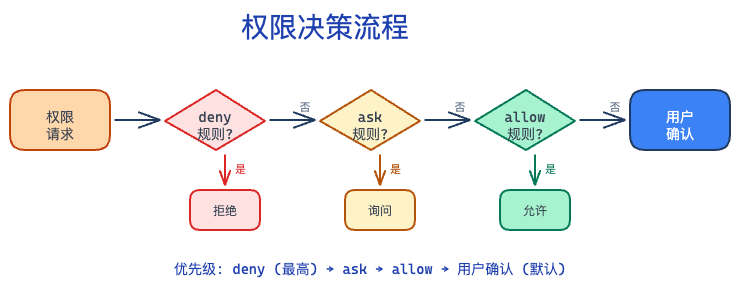
3.4 规则优先级
// 规则优先级处理
function resolvePermission(
  request: PermissionRequest,
  rules: PermissionRules
): PermissionDecision {
  // 1. deny 规则最高优先级
  for (const rule of rules.deny ?? []) {
    if (matchRule(request, rule).matched) {
      return {
        allowed: false,
        reason: `Denied by rule: ${rule}`,
        source: getRuleSource(rule),
      }
    }
  }

  // 2. ask 规则需要确认
  for (const rule of rules.ask ?? []) {
    if (matchRule(request, rule).matched) {
      return {
        allowed: false,
        needsConfirmation: true,
        message: `Requires confirmation: ${rule}`,
        source: getRuleSource(rule),
      }
    }
  }

  // 3. allow 规则允许
  for (const rule of rules.allow ?? []) {
    if (matchRule(request, rule).matched) {
      return {
        allowed: true,
        source: getRuleSource(rule),
      }
    }
  }

  // 4. 无匹配规则,走默认流程
  return {
    allowed: false,
    needsConfirmation: true,
    message: 'No matching permission rule',
  }
}
4. 危险操作AI分类器
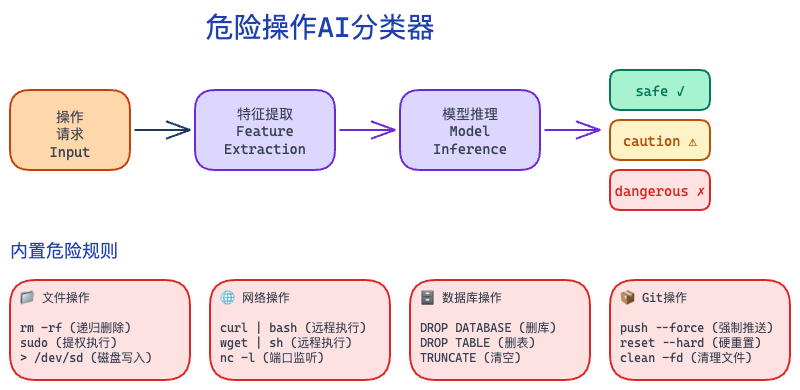
4.1 分类器架构
// services/classifier/transcriptClassifier.ts
export class DangerousOperationClassifier {
  // 分类操作的危险级别
  async classify(request: PermissionRequest): Promise<DangerLevel> {
    const prompt = this.buildClassificationPrompt(request)

    const response = await this.llm.classify(prompt)

    return {
      level: response.level,  // 'safe' | 'caution' | 'dangerous'
      reason: response.reason,
      confidence: response.confidence,
    }
  }

  private buildClassificationPrompt(request: PermissionRequest): string {
    return `
Analyze this operation and classify its danger level:

Tool: ${request.tool}
Input: ${JSON.stringify(request.input, null, 2)}
Working Directory: ${request.cwd}

Classify as:
- safe: Read-only, no side effects
- caution: Moderate risk, reversible
- dangerous: High risk, potentially irreversible

Provide:
1. Danger level
2. Reasoning
3. Confidence (0-1)
`
  }
}
4.2 内置分类规则
// 内置分类规则
const CLASSIFICATION_RULES: ClassificationRule[] = [
  // 文件操作
  {
    pattern: /rm\s+-rf/,
    level: 'dangerous',
    reason: 'Recursive force delete is irreversible',
  },
  {
    pattern: /sudo/,
    level: 'dangerous',
    reason: 'Elevated privileges required',
  },
  {
    pattern: />\s*\/dev\/sd/,
    level: 'dangerous',
    reason: 'Direct disk write',
  },

  // 网络操作
  {
    pattern: /curl.*\|\s*bash/,
    level: 'dangerous',
    reason: 'Remote code execution',
  },
  {
    pattern: /wget.*\|\s*sh/,
    level: 'dangerous',
    reason: 'Remote code execution',
  },

  // 数据库操作
  {
    pattern: /DROP\s+(DATABASE|TABLE)/i,
    level: 'dangerous',
    reason: 'Irreversible data loss',
  },
]
5. 交互式权限确认
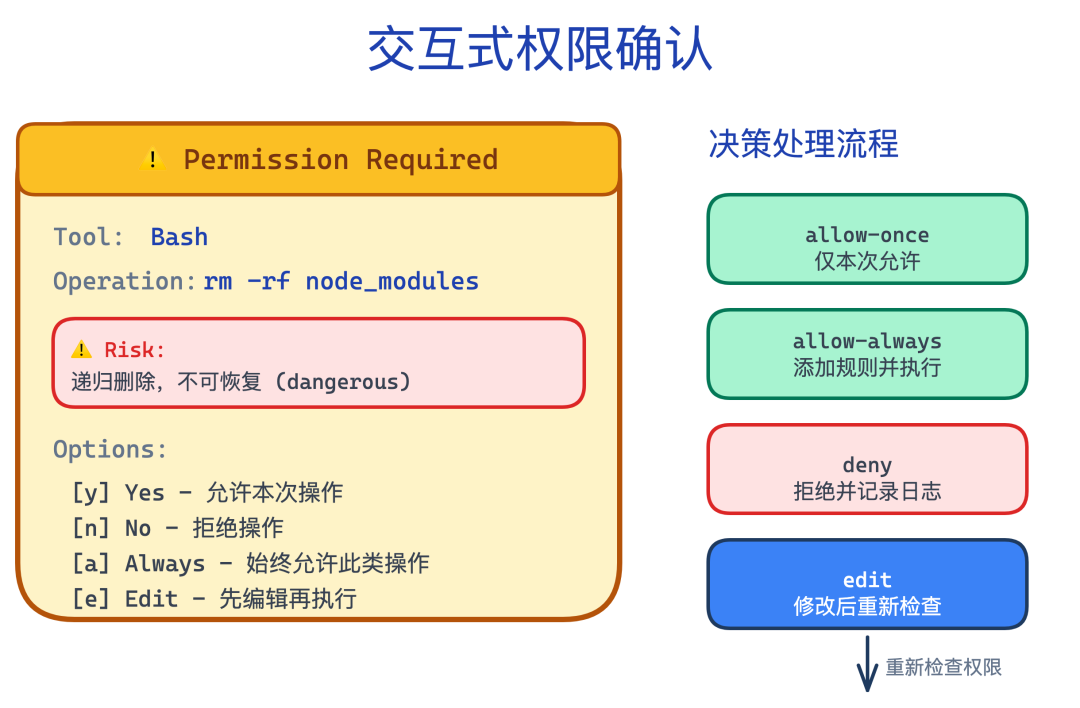
5.1 确认对话框设计
// components/PermissionDialog.tsx
export function PermissionDialog({
  request,
  onDecision,
}: PermissionDialogProps) {
  return (
    <Box flexDirection="column" borderStyle="round" borderColor="yellow">
      <Text bold color="yellow">
        Permission Required
      </Text>

      <Box marginTop={1}>
        <Text>Tool: </Text>
        <Text bold>{request.tool}</Text>
      </Box>

      <Box>
        <Text>Operation: </Text>
        <Text>{formatOperation(request.input)}</Text>
      </Box>

      {request.riskAnalysis && (
        <Box marginTop={1}>
          <Text color="red">
            Risk: {request.riskAnalysis.reason}
          </Text>
        </Box>
      )}

      <Box marginTop={1}>
        <Text dimColor>Options:</Text>
      </Box>

      <Text>  [y] Yes, allow this operation</Text>
      <Text>  [n] No, deny this operation</Text>
      <Text>  [a] Always allow this type of operation</Text>
      <Text>  [e] Edit the operation first</Text>
      <Text>  [Esc] Cancel</Text>

      <InputHandler onKey={handleKey} />
    </Box>
  )
}
5.2 决策处理
// 处理用户决策
async function handlePermissionDecision(
  decision: PermissionDecision,
  request: PermissionRequest
): Promise<void> {
  switch (decision) {
    case 'allow-once':
      // 仅本次允许
      await executeWithPermission(request)
      break

    case 'allow-always':
      // 添加到允许规则
      await addPermissionRule({
        type: 'allow',
        rule: generateRuleFromRequest(request),
        source: 'user',
      })
      await executeWithPermission(request)
      break

    case 'deny':
      // 拒绝
      logPermissionDenied(request)
      break

    case 'edit':
      // 编辑操作
      const editedInput = await editOperation(request.input)
      request.input = editedInput
      // 重新检查权限
      await checkAndExecute(request)
      break
  }
}
6. Git集成安全操作
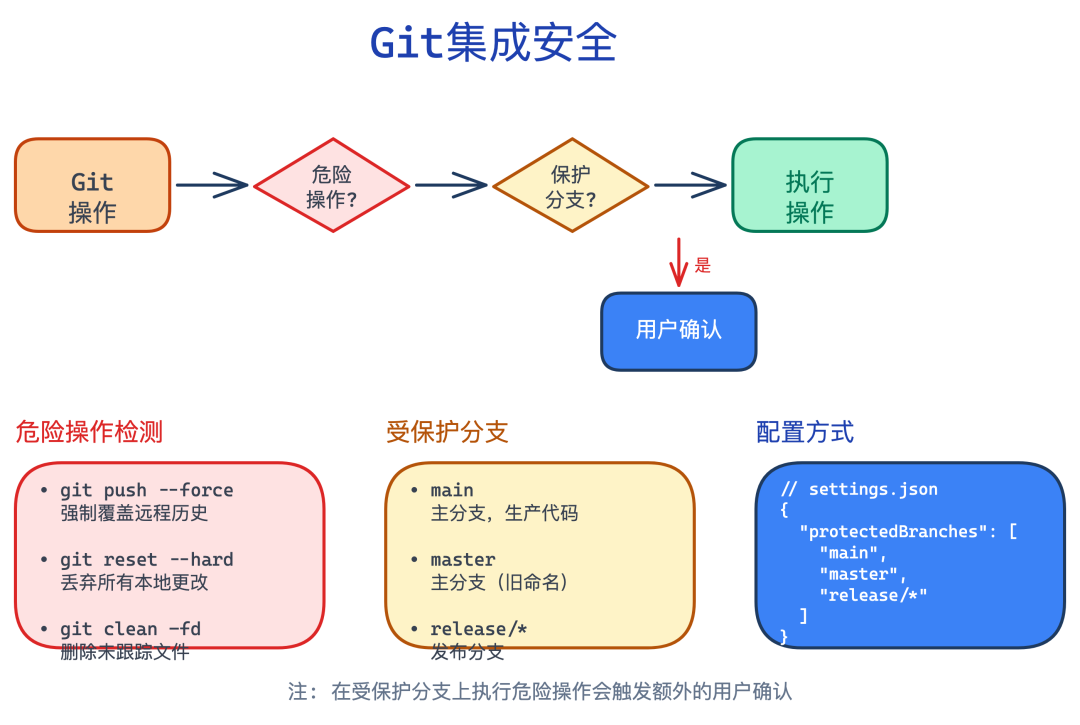
6.1 Git操作特殊处理
// utils/git/permissions.ts
export function checkGitOperation(
  operation: GitOperation,
  context: ToolUseContext
): PermissionResult {
  // 危险的Git操作
  const dangerousOperations = [
    'push --force',
    'reset --hard',
    'clean -fd',
    'checkout -- .',
  ]

  if (dangerousOperations.some(op => operation.command.includes(op))) {
    return {
      allowed: false,
      needsConfirmation: true,
      message: `Dangerous Git operation: ${operation.command}`,
      riskLevel: 'high',
    }
  }

  // 检查是否在受保护分支
  const protectedBranches = context.settings.protectedBranches ?? ['main', 'master']
  const currentBranch = getCurrentBranch()

  if (protectedBranches.includes(currentBranch)) {
    if (operation.type === 'force-push' || operation.type === 'reset') {
      return {
        allowed: false,
        needsConfirmation: true,
        message: `Operation on protected branch: ${currentBranch}`,
        riskLevel: 'high',
      }
    }
  }

  return { allowed: true }
}
7. 审计与日志
7.1 权限审计日志
// services/audit/permissionAudit.ts
export function logPermissionDecision(
  request: PermissionRequest,
  decision: PermissionDecision
): void {
  const auditEntry: AuditEntry = {
    timestamp: new Date().toISOString(),
    sessionId: request.sessionId,

    // 请求信息
    tool: request.tool,
    input: sanitizeInput(request.input),

    // 决策信息
    decision: decision.type,
    reason: decision.reason,
    source: decision.source,  // 'user' | 'rule' | 'auto'

    // 上下文
    cwd: request.cwd,
    userId: request.userId,
  }

  // 写入审计日志
  appendAuditLog(auditEntry)

  // 发送到分析服务
  logEvent('permission_decision', auditEntry)
}
7.2 审计报告
// 生成权限审计报告
export function generateAuditReport(
  sessionId: SessionId
): PermissionAuditReport {
  const entries = getAuditEntries(sessionId)

  return {
    totalOperations: entries.length,

    byDecision: {
      allowed: entries.filter(e => e.decision === 'allow').length,
      denied: entries.filter(e => e.decision === 'deny').length,
      confirmed: entries.filter(e => e.decision === 'confirmed').length,
    },

    byTool: groupBy(entries, 'tool'),

    highRiskOperations: entries.filter(e => e.riskLevel === 'high'),

    // 时间分布
    timeline: generateTimeline(entries),
  }
}
8. 安全边界设计
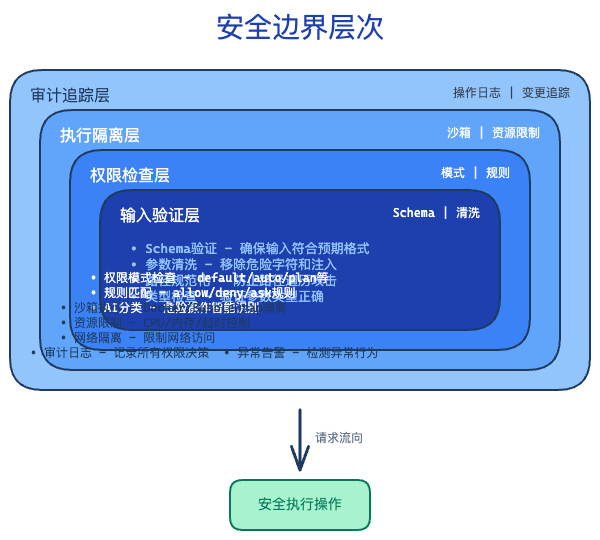
8.1 多层防护
安全边界层次
├── 输入验证层
│   ├── Schema验证
│   ├── 参数清洗
│   └── 路径规范化
│
├── 权限检查层
│   ├── 模式检查
│   ├── 规则匹配
│   └── AI分类
│
├── 执行隔离层
│   ├── 沙箱执行
│   ├── 资源限制
│   └── 超时控制
│
└── 审计追踪层
    ├── 操作日志
    ├── 变更追踪
    └── 异常告警
8.2 沙箱执行
// sandbox/executor.ts
export async function executeInSandbox<T>(
  operation: () => Promise<T>,
  options: SandboxOptions
): Promise<T> {
  // 1. 创建隔离环境
  const sandbox = await createSandbox(options)

  try {
    // 2. 设置资源限制
    sandbox.setMemoryLimit(options.memoryLimit ?? '512M')
    sandbox.setCpuLimit(options.cpuLimit ?? '50%')
    sandbox.setTimeout(options.timeout ?? 30000)

    // 3. 执行操作
    const result = await sandbox.run(operation)

    return result
  } finally {
    // 4. 清理环境
    await sandbox.cleanup()
  }
}
9. 最佳实践总结
9.1 安全配置检查清单
- •配置适当的权限模式
- •设置deny规则防止危险操作
- •配置protected分支
- •启用审计日志
- •定期审查权限规则
9.2 常见安全陷阱
- 1. 过度信任AI - AI决策需要人工确认
- 2. 规则冲突 - deny规则应该优先
- 3. 路径遍历 - 验证所有文件路径
- 4. 命令注入 - 清理所有用户输入
实践练习
- 1. 配置权限规则 - 创建allow/deny规则
- 2. 实现自定义分类器 - 添加特定领域的危险检测
- 3. 审计分析 - 分析权限日志,发现异常模式
- 4. 安全加固 - 为特定工具添加额外检查
下一篇预告
第6篇:LLM集成 - API客户端与流式响应 - 深入理解 Claude Code 如何与 Claude API 高效交互。
本文参与 腾讯云自媒体同步曝光计划,分享自微信公众号。
原始发表:2026-04-02,如有侵权请联系 cloudcommunity@tencent.com 删除
目录
腾讯云开发者

Copyright © 2013 - 2026 Tencent Cloud. All Rights Reserved. 腾讯云 版权所有
深圳市腾讯计算机系统有限公司 ICP备案/许可证号:粤B2-20090059  粤公网安备44030502008569号
腾讯云计算(北京)有限责任公司 京ICP证150476号 | 京ICP备11018762号