
计算机网络:在第70节发送的传输周期是什么?
计算机网络:在第70节发送的传输周期是什么?
提问于 2018-05-14 19:57:59
在练习一些练习的时候,我遇到了下面的练习,我就是不能把我的头绕起来。看这个解决方案,我不知道他们是如何得出结论的,即第六轮传输中,32到63分组被发送出去了。63是如何计算出来的?
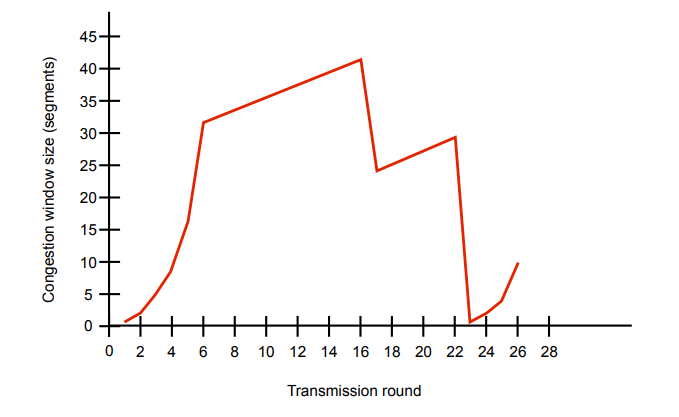
在第70段发送的传输周期是什么?
解决方案:
During the 1st transmission round, packet 1 is sent;
packet 2-3 are sent in the 2nd transmission round;
packets 4-7 are sent in the 3rd transmission round;
packets 8-15 are sent in the 4th transmission round;
packets 16 to 31 are sent in the 5th transmission round;
packets 32 to 63 are sent in the 6th transmission round;
packets 64 to 96 are sent in the 7th transmission round.
Thus packet 70 is sent in the 7th transmission round.回答 1
Stack Overflow用户
发布于 2018-05-24 12:50:20
通过提供练习链接,我们可以看到,在练习1中,TCP传输从慢开始到第6轮拥塞避免(我们可以看到图的变化梯度,下一段是为什么)。
根据RFC 2001 Article .1 & .2 (链接),我们可以看到,当我们进入到TCP拥塞避免时,拥塞窗口大小(cwnd)只会增加1次传输回合。
再次查看练习(以及上面的说明),我们看到正在传输以下段大小(--注意数据包是包含的,因此传输第6轮包含32个数据包,第7轮包含33个数据包):
During the 1st transmission round, packet 1 is sent;      | Current Window Size of (1)
packet 2-3 are sent in the 2nd transmission round;        | Increase window by 1 segment (2)
packets 4-7 are sent in the 3rd transmission round;       | Increase window by 2 segments (4)
packets 8-15 are sent in the 4th transmission round;      | Increase window by 4 segments (8)
packets 16 to 31 are sent in the 5th transmission round;  | Increase window by 8 segments (16)
packets 32 to 63 are sent in the 6th transmission round;  | Increase window by 16 segments (32)
*** Here we switch to Congestion Avoidance
packets 64 to 96 are sent in the 7th transmission round.  | Increase windows by 1 segment (33)
由于分组包括在内,通过声明分组32,一直到并包括分组63 (因此,让我们设想分组63的末尾基本上是分组64的开始),这个练习是正确的,从而构成了第6轮传输。
页面原文内容由Stack Overflow提供。腾讯云小微IT领域专用引擎提供翻译支持
原文链接:
https://stackoverflow.com/questions/50338091
复制相关文章
相似问题
腾讯云开发者

Copyright © 2013 - 2026 Tencent Cloud. All Rights Reserved. 腾讯云 版权所有
深圳市腾讯计算机系统有限公司 ICP备案/许可证号:粤B2-20090059  粤公网安备44030502008569号
腾讯云计算(北京)有限责任公司 京ICP证150476号 | 京ICP备11018762号