
协议Swift 4字典
我有一个叫做可播放的协议,它需要func play()的实现。类Damage和DrawACard都符合协议。
protocol Playable: class {
    func play(game: Game, value: Int) -> Player
}


class Damage: Playable, Hashable, Equatable {

    var hashValue: Int = 1

    static func ==(lhs: Damage, rhs: Damage) -> Bool {
        return lhs.hashValue == rhs.hashValue
    }

    func play(game: Game, value: Int) -> Player {
        // do stuff
        return game.activePlayer
    }
}

class DrawACard: Playable, Equatable, Hashable {

    var hashValue: Int = 2

    static func ==(lhs: DrawACard, rhs: DrawACard) -> Bool {
        return lhs.hashValue == rhs.hashValue
    }

    func play(game: Game, value: Int) -> Player {
        // do stuff
        return game.activePlayer
    }
}
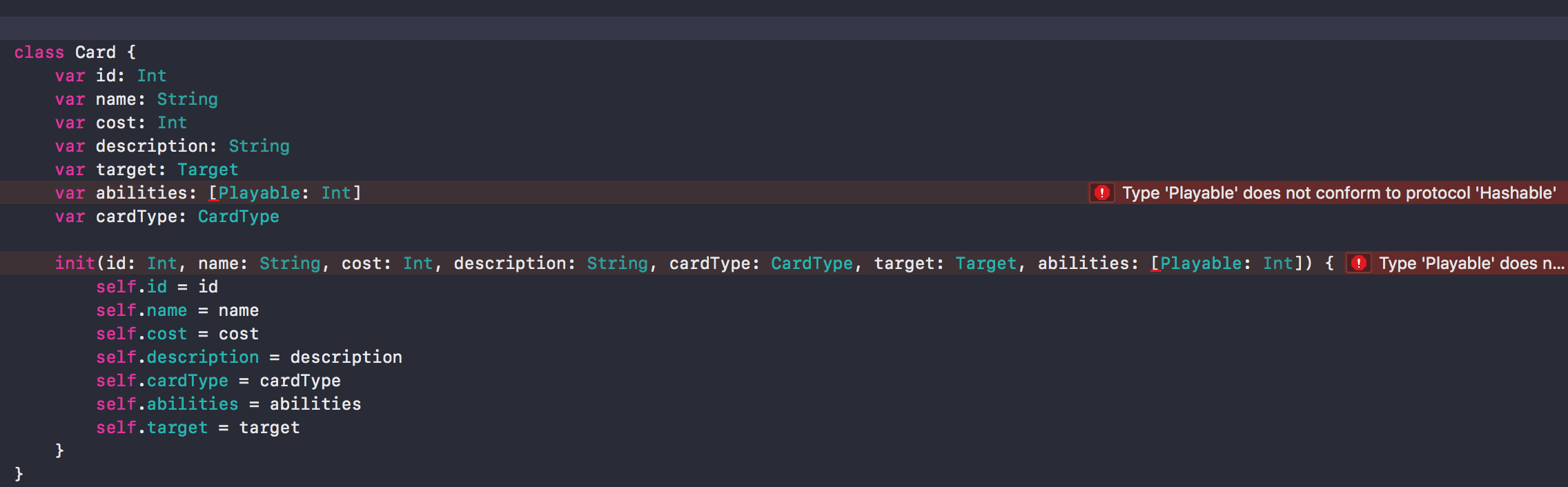
我的问题如下:
class Card {
    var id: Int
    var name: String
    var cost: Int
    var description: String
    var target: Target
    var abilities: [Playable: Int]
    var cardType: CardType

    init(id: Int, name: String, cost: Int, description: String, cardType: CardType, target: Target, abilities: [Playable: Int]) {
        self.id = id
        self.name = name
        self.cost = cost
        self.description = description
        self.cardType = cardType
        self.abilities = abilities
        self.target = target
    }
}类abilities中的第6个变量在我尝试将协议作为密钥时抛出一个错误。它给了我:Type 'Playable' does not conform to protocol 'Hashable'。
我希望能力变量具有实现Playable的对象的键和Int的值,例如。abilities = [DrawACard: 5]
我该怎么做呢?
回答 3
Stack Overflow用户
发布于 2018-03-25 19:20:01
这种具有类继承的混合协议非常复杂。您的具体问题的答案是您不能直接这样做,因为如果您使Playable符合Hashable,那么您就不能创建它们的数组。
最简单的解决方案是这里不使用协议。做个抽象的课。Swift不太擅长抽象类,但它们将使这些问题大部分消失。
考虑到您的具体情况,我还可以考虑对Playable使用枚举,而不是使用协议。这可能会使事情变得更简单。
从那以后,解决方案就变得更加复杂了。例如,您可以按照我的ClassDictionary实验的思路创建一个ClassSet。或者你可以做一个类型橡皮。但事情变得很丑陋。
您还可以考虑从类切换到结构,去掉字典,只使用Array。如果Int的点是计数,那么只需拥有结构的多个副本。如果Int的点是一个参数(比如“多少损坏”),那么这应该在Damage结构中,而不是在字典中。
(不相关的注意,您的散列值非常奇怪。它们会起作用的,但哈希不是这样工作的。)
举个例子,我看到的是:
protocol Playable {
    func play(game: Game) -> Player
}

struct Damage: Playable {
    let amount: Int

    func play(game: Game) -> Player {
        // do stuff
        return game.activePlayer
    }
}

struct DrawACard: Playable {
    func play(game: Game) -> Player {
        // do stuff
        return game.activePlayer
    }
}

struct Card {
    let id: Int
    let name: String
    let cost: Int
    let description: String
    let cardType: CardType
    let target: Target
    let abilities: [Playable]
}

// A card that inflicts one damage
let card = Card(id: 1,
                name: "Strike",
                cost: 1,
                description: "Strike 'em",
                cardType: CardType(),
                target: Target(),
                abilities: [Damage(amount: 1)])
这是有意将所有内容转换为不可变的结构;我相信这里所描述的一切实际上都是值类型。
Stack Overflow用户
发布于 2018-03-25 19:47:56
我会将类的定义更改为此,这样类继承自一个Hashable基类:
class PlayableClass: Hashable {

    var hashValue: Int = 0

    static func ==(lhs: PlayableClass, rhs: PlayableClass) -> Bool {
        return true
    }
}

class Damage: PlayableClass, Playable {

    override init() {
        super.init()
        hashValue = 1
    }

   ...
}

class DrawACard: PlayableClass, Playable {

    override init() {
        super.init()
        hashValue = 2
    }

    ...
}

class Card {
    ...
    var abilities: [PlayableClass: Int]
    ...

    init(id: Int, name: String, cost: Int, description: String, abilities: [PlayableClass: Int]) {
        ...
    }
}Stack Overflow用户
发布于 2020-09-07 18:00:01
这可能不会直接回答这个问题,但是,它可能会对这个问题的未来读者有所帮助。
一个想法是使用AnyHashable并使用强制转换来获取/设置所需的内容。
定义你的字典:
var abilities: [AnyHashable: Int] = [:]然后创建一些方法来添加/删除字典中的项。
func addPlayable<T: Playable>(_ myPlayable: T) where T:Hashable {
    abilities[myPlayable] = 0
}

func removePlayable<T: Playable>(_ myPlayable: T) where T:Hashable {
    abilities.removeValue(forKey: myPlayable)
}
访问这样的元素:
func getValue<T: Playable>(_ obj: T) -> Int? where T:Hashable {
    return abilities[obj]
}
或者,如果您想迭代字典,可以这样做:
abilities.forEach { (it) in
    (it.key as? Playable)?.play(...)
}https://stackoverflow.com/questions/49479839
复制相似问题
腾讯云开发者

Copyright © 2013 - 2026 Tencent Cloud. All Rights Reserved. 腾讯云 版权所有
深圳市腾讯计算机系统有限公司 ICP备案/许可证号:粤B2-20090059  粤公网安备44030502008569号
腾讯云计算(北京)有限责任公司 京ICP证150476号 | 京ICP备11018762号