
L2正则化技术在mllib中的应用
L2正则化技术在mllib中的应用
提问于 2015-09-04 17:54:45
我在用L2正则化读取SGD的开源mllib代码时遇到了困难。
代码是
class SquaredL2Updater extends Updater {
override def compute(
  weightsOld: Vector,
  gradient: Vector,
  stepSize: Double,
  iter: Int,
  regParam: Double): (Vector, Double) = {
// add up both updates from the gradient of the loss (= step) as well as
// the gradient of the regularizer (= regParam * weightsOld)
// w' = w - thisIterStepSize * (gradient + regParam * w)
// w' = (1 - thisIterStepSize * regParam) * w - thisIterStepSize * gradient
val thisIterStepSize = stepSize / math.sqrt(iter)
val brzWeights: BV[Double] = weightsOld.toBreeze.toDenseVector
brzWeights :*= (1.0 - thisIterStepSize * regParam)
brzAxpy(-thisIterStepSize, gradient.toBreeze, brzWeights)
val norm = brzNorm(brzWeights, 2.0)

(Vectors.fromBreeze(brzWeights), 0.5 * regParam * norm * norm)
}
我遇到麻烦的地方是
brzWeights :*= (1.0 - thisIterStepSize * regParam)微风库有解释:*=操作符的文档。
/** Mutates this by element-wise multiplication of b into this. */
final def :*=[TT >: This, B](b: B)(implicit op: OpMulScalar.InPlaceImpl2[TT, B]): This = {
 op(repr, b)
 repr
}
它看起来就像向量被标量相乘一样。
在L2正则化情况下,我找到的梯度公式是
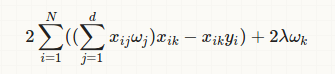
在此更新中,代码如何表示此梯度?有人能帮忙吗。
回答 1
Stack Overflow用户
回答已采纳
发布于 2015-09-08 23:05:45
好吧,我想出来了。更新者方程是

重新排列条款

识别最后一项只是梯度。

这相当于代码中的
brzAxpy(-thisIterStepSize, gradient.toBreeze, brzWeights)把它弄出来
brzWeights = brzWeights + -thisIterStepSize * gradient.toBreeze在上一行中,brzWeights :*= (1.0 - thisIterStepSize * regParam)
这意味着brzWeights = brzWeights * (1.0 - thisIterStepSize * regParam)
所以,终于
brzWeights = brzWeights * (1.0 - thisIterStepSize * regParam) + (-thisIterStepSize) * gradient.toBreeze现在,代码和方程在一个归一化因子内匹配,我相信这在下面的行中得到了处理。
页面原文内容由Stack Overflow提供。腾讯云小微IT领域专用引擎提供翻译支持
原文链接:
https://stackoverflow.com/questions/32403958
复制相关文章
相似问题
腾讯云开发者

Copyright © 2013 - 2026 Tencent Cloud. All Rights Reserved. 腾讯云 版权所有
深圳市腾讯计算机系统有限公司 ICP备案/许可证号:粤B2-20090059  粤公网安备44030502008569号
腾讯云计算(北京)有限责任公司 京ICP证150476号 | 京ICP备11018762号