
递归地将多维数据集分解为8个较小的立方体(当多维数据集由中间点和大小定义时)
我在工作上遇到了麻烦,所以我会很感激你的帮助。
短版本:给定一个立方体的中点和大小,我需要将它分割成8个较小的(2x2x2),并可能对其中的每一个重复。得到的坐标是唯一需要的。
我正在编写一些八叉树风格的代码,我试图允许它接受不同深度的输入(深度与点之间的间距有关,即2^depth,例如。深度0有1单位网格,深度-1有0.5,深度1有2)。我需要它能够在更高的深度得到一个坐标,并把它分解成适合实际深度的立方体。
例如,如果(0,0,0)点位于深度1,场景为深度0,则需要将其分解为8块,并将每个+-0.5单元移动到旧的多维数据集(2^(depth-1))中。
如果场景在深度-1,我需要把它分成8块,然后再把它们分成8块。我基本上需要它给出8^(difference in depth)的结果,这听起来很容易做,但它完全让我困惑,它的错误。
#Set up structure
octreeRange = ( 1, -1 )
octreeStructure = set()
for x in octreeRange:
    for y in octreeRange:
        for z in octreeRange:
            octreeStructure.add( ( x, y, z ) )

#octreeStructure is the 8 coordinates that a cube can split into

def recursiveCoordinate( coordinate, coordinateInfo, minDepthLevel, octreeStructure ):

    newDictionary = {}

    #Turn into list if isn't already list
    if type( coordinateInfo ) != list:
        coordinateInfo = [coordinateInfo,minDepthLevel]

    coordinateDepth = coordinateInfo[1]

    #Run function again for each coordinate that has a depth too high
    if coordinateDepth > minDepthLevel:
        coordinateInfo[1] -= 1
        moveAmount = pow( 2, coordinateDepth-1 )
        for i in octreeStructure:
            newCoordinate = [i[j]*moveAmount+coordinate[j] for j in xrange( 3 )]
            newDictionary.update( recursiveCoordinate( newCoordinate, coordinateInfo, minDepthLevel, octreeStructure ) )

    else:
        newDictionary[tuple( coordinate )] = coordinateInfo

    return newDictionary

minDepthLevel = 0
grid = {}
#grid[(x, y, z)] = [block ID, depth level]
grid[(1.5,0,0)] = [1,2]

newGrid = {}
for coordinate in grid:
    newGrid.update( recursiveCoordinate( coordinate, grid[coordinate], minDepthLevel, octreeStructure ) )
print len( newGrid.keys() )
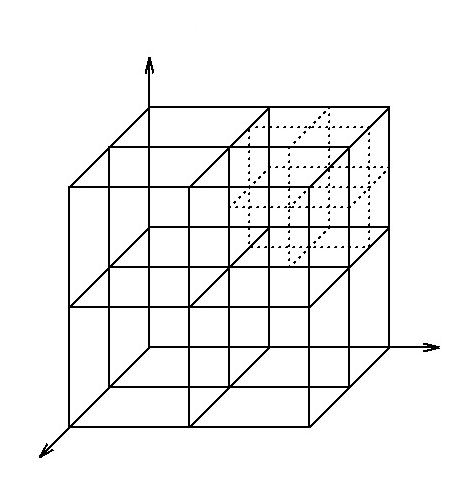
为了获得视觉效果,拍下这张照片。当场景为0级时,中间点位于中间,定义为深度2级。实心黑线是第一次迭代,虚线是第二次也是最后一次迭代。我需要所有虚线立方体中点的坐标。
我想另一种方法是根据深度计算立方体的大小,然后将其分割成所需的部分,但这需要3个嵌套循环,可能要通过数千个值,所以如果可能的话,我想避免嵌套循环。
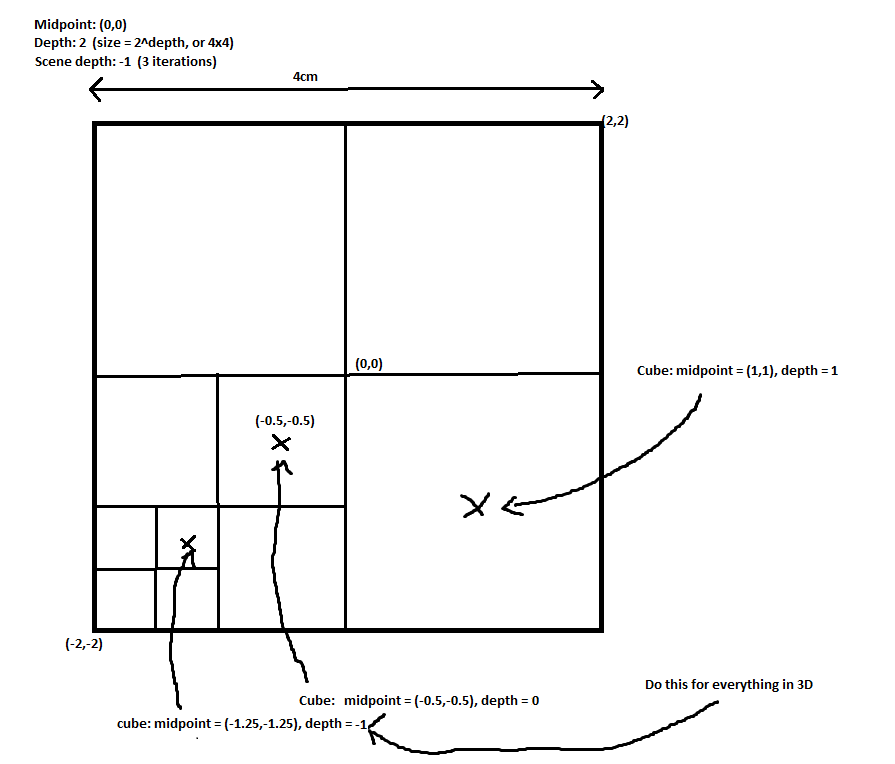
编辑:一个快速的事情,我在油漆作为一个2D的例子,你可以看到为什么我认为这将是超级容易。最后的结果,经过3次迭代,将产生64个坐标,将适合现场。
回答 1
Stack Overflow用户
发布于 2015-03-24 18:31:03
我仍然不太确定这是否是你想要的,但下面是我要怎么做的:
首先,我要创建一个类,表示3D空间中的点:
class Point3D:
    """Representation of a point in 3D space."""
    def __init__(self, x, y, z):
        self.x = x
        self.y = y
        self.z = z

    def __add__(self, other):
        """Add two points.

        >>> Point3D(1, 2, 3) + Point3D(100, 200, 300)
        Point3D(101, 202, 303)
        """
        x = self.x + other.x
        y = self.y + other.y
        z = self.z + other.z
        return Point3D(x, y, z)

    def __mul__(self, a):
        """Multiply a point with a number.

        >>> Point3D(1, 2, 3) * 2
        Point3D(2, 4, 6)
        """
        x = self.x * a
        y = self.y * a
        z = self.z * a
        return Point3D(x, y, z)

    def __rmul__(self, a):
        """Multiply a number with a point.

        >>> 2 * Point3D(1, 2, 3)
        Point3D(2, 4, 6)
        """
        return self.__mul__(a)

    def __repr__(self):
        return 'Point3D({p.x}, {p.y}, {p.z})'.format(p=self)
这允许在计算派生多维数据集的中心点时使用更易读的代码。
然后我会创建一个类来表示多维数据集。实例可以被分成八个部分,并且知道它们的“深度”,这对于被分割的立方体来说是减少的。
必须移动中心点的八个方向使用itertools.product获得,并表示为Point3D对象,其各自的坐标设置为-1/+1。(我已经给出了简称为octreeStructure的简称DIR )。
多维数据集对象有一个向下一级的辅助函数_divide,它用于递归函数divide,该函数从多维数据集的深度下降到目标深度。
注意二维列表理解,它用于生成一个扁平的列表.
from __future__ import division
from itertools import product

class Cube:
    """Representation of a cube."""

    # directions to all eight corners of a cube
    DIR = [Point3D(*s) for s in product([-1, +1], repeat=3)]

    def __init__(self, center, size, depth=0):
        if not isinstance(center, Point3D):
            center = Point3D(*center)
        self.center = center
        self.size = size
        self.depth = depth

    def __repr__(self):
        return 'Cube(center={c.center}, size={c.size}, depth={c.depth})'.format(c=self)

    def _divide(self):
        """Divide into eight cubes of half the size and one level deeper."""
        c = self.center
        a = self.size/2
        d = self.depth - 1
        return [Cube(c + a/2*e, a, d) for e in Cube.DIR]

    def divide(self, target_depth=0):
        """Recursively divide down to the given depth and return a list of
        all 8^d cubes, where d is the difference between the depth of the
        cube and the target depth, or 0 if the depth of the cube is already
        equal to or less than the target depth.

        >>> c = Cube(center=(0, 0, 0), size=2, depth=1)
        >>> len(c.divide(0))
        8
        >>> len(c.divide(-1))
        64
        >>> c.divide(5)[0] is c
        True
        >>> c.divide(-1)[0].size
        0.5
        """
        if self.depth <= target_depth:
            return [self]
        smaller_cubes = self._divide()
        return [c for s in smaller_cubes for c in s.divide(target_depth)]
您的示例如下所示:
# minDepthLevel = 0
# grid = {}
# grid[(1.5,0,0)] = [1,2]
# not sure what this ^ 1 means

cube = Cube((1.5, 0, 0), 4, 2)
grid = {c.center: [1, c.depth] for c in cube.divide(0)}https://stackoverflow.com/questions/29237493
复制相似问题
腾讯云开发者

Copyright © 2013 - 2026 Tencent Cloud. All Rights Reserved. 腾讯云 版权所有
深圳市腾讯计算机系统有限公司 ICP备案/许可证号:粤B2-20090059  粤公网安备44030502008569号
腾讯云计算(北京)有限责任公司 京ICP证150476号 | 京ICP备11018762号