
有3个容器(2个满的和1个空的),并试图从其中创建x值
注意:--我遇到了下面的问题,我想概括这个问题并实现它,但是事实证明,这并不容易。这个问题让我发疯了。这不是家庭作业问题,只是好奇。
问题
有三个容器,大小分别为10品脱、7品脱和4品脱。7品脱和4品脱的容器开始充满了水,但10品脱的容器最初是空的。 由于容器上没有标记,您可以将一个容器的内容倒入另一个容器,并在以下条件下停止:
- 源容器为空。
- 目标容器已满。
如果你想准确地分离2品脱的水,你应该采取什么步骤?
资料来源:第102页,问题3.8。
解决方案
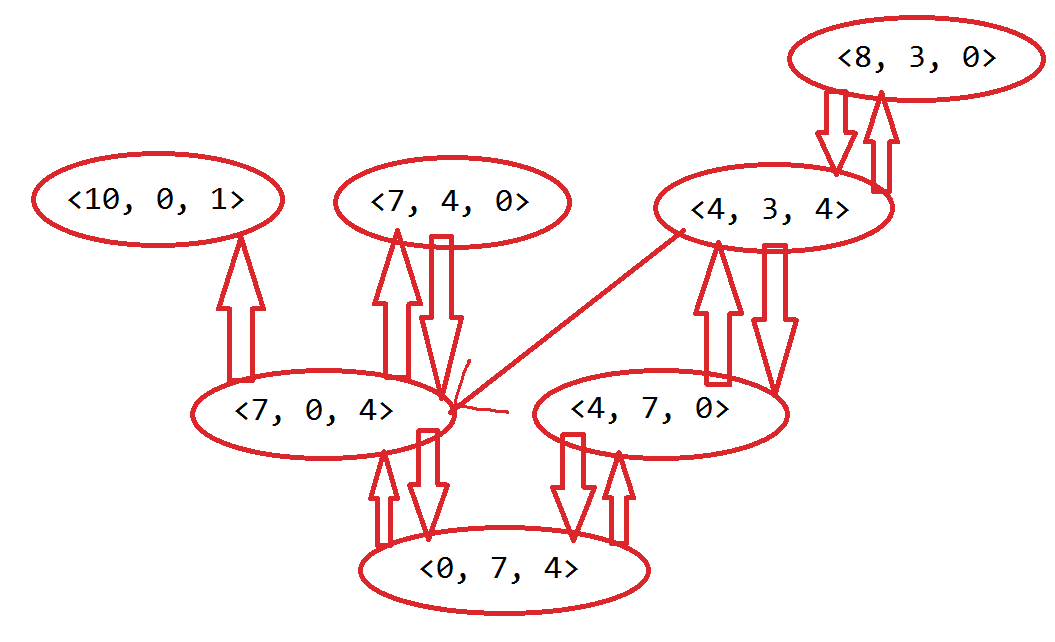
使用有向图数据结构很容易回答这个问题,其中节点包含tuples来表示特定的状态。
我们从初始状态(节点)开始,然后创建一个表示可能的下一个状态的节点,并将其连接到初始节点,然后运行BFS以找到最短路径。
- 每个状态(或节点)的模式:
<10-pint container, 7-pint container, 4-pint container> - 初始状态或节点:
<0, 7, 4>。
连接到初始状态(或节点)的节点:<7, 0, 4>,<4, 7, 0>,从图片中可以看到。
泛化问题
但是假设如果想推广这个问题,假设我们有三个容器,它们的大小分别是x、y和z品脱,因此
x >= y >= z。 Y-品脱和z-品脱容器开始充满了水,但x-品脱容器最初是空的。 如果你想准确地分离出一品脱的水,你应该采取什么步骤?
建议通用版本的解决方案
以下是主类中两个重要的方法。它们根据所有可能性填充图表,并确保没有重复节点。
public static void fillGraph(int x, int y, int z) {

    TupleContainer initialState = new TupleContainer(x, y, z);
    TupleContainer currentState = initialState;
    Iterator<TupleContainer> it, it_1, it_2, it_3;
    Graph.addNode(initialState);

    it = addAdjacentEdgesToTuple(currentState).iterator();
    while (it.hasNext()) {
        it_1 = addAdjacentEdgesToTuple(it.next()).iterator();
        while (it_1.hasNext()) {
            it_2 = addAdjacentEdgesToTuple(it.next()).iterator();
            while (it_2.hasNext()) {
                it_3 = addAdjacentEdgesToTuple(it.next()).iterator();
                while (it_3.hasNext()) {
                    addAdjacentEdgesToTuple(it.next()).iterator();
                }
            }
        }
    }

public static Collection<TupleContainer> addAdjacentEdgesToTuple(
        TupleContainer currentState) {
    TupleContainer tempTupleContainer;
    Collection<TupleContainer> CollectionLevel;
    Iterator<TupleContainer> it;

    CollectionLevel = currentState.MixUpContainers();
    it = CollectionLevel.iterator();

    while (it.hasNext()) {
        tempTupleContainer = it.next();
        if (graphContains(tempTupleContainer) != null)
            Graph.addNode(tempTupleContainer);
        else
            tempTupleContainer = graphContains(tempTupleContainer);
        Graph.addEdge(currentState, tempTupleContainer);
    }
    return CollectionLevel;
}
我的问题
我的代码只将图填充到4的深度,但如何设置深度并使其递归运行,或者如何使其运行,直到考虑到所有可能性而不进入无限循环。这个广义问题的算法是什么?
回答 2
Stack Overflow用户
发布于 2014-12-07 22:40:38
嗯..。可能有更好的算法,但是如果您只是想要任意深度的递归而不进入无穷无尽的循环,您可以使用宽度优先搜索,只访问每个节点一次,也就是说,如果还没有访问过它:
public class Test {

    public static void main(String[] args) throws Exception {
        State initialState = new State(null, 0, 7, 4);

        Set<State> reached = new HashSet<>();
        Queue<State> pending = new ArrayDeque<>();
        pending.add(initialState);
        while (!pending.isEmpty()) {
            State state = pending.remove();

            if (isGoal(state)) {
                printPathTo(state);
                return;
            }

            for (State s : state.adjacentStates()) {
                if (!reached.contains(s)) {
                    reached.add(s);
                    pending.add(s);
                }
            }
        }

        System.out.println("There appears to be no solution.");
    }

    private static boolean isGoal(State state) {
        for (int a : state.content) {
            if (a == 2) {
                return true;
            }
        }
        return false;
    }

    private static void printPathTo(State state) {
        if (state != null) {
            printPathTo(state.previous);
            System.out.println(state);
        }
    }
}

class State {

    final static int[] capacity = { 10, 7, 4 };

    final int[] content;
    final State previous;

    public State(State previous, int... content) {
        this.content = content;
        this.previous = previous;
    }

    Iterable<State> adjacentStates() {
        List<State> result = new ArrayList<>();
        for (int i = 0; i < content.length; i++) {
            for (int j = 0; j < content.length; j++) {
                if (i != j) {
                    int[] newContent = Arrays.copyOf(content, content.length);
                    int movedQuantity = Math.min(content[i], capacity[j] - content[j]);
                    newContent[i] -= movedQuantity;
                    newContent[j] += movedQuantity;
                    result.add(new State(this, newContent));
                }
            }
        }
        return result;
    }

    @Override
    public int hashCode() {
        return Arrays.hashCode(content);
    }

    @Override
    public boolean equals(Object obj) {
        return Arrays.equals(content, ((State) obj).content);
    }

    @Override
    public String toString() {
        return Arrays.toString(content);
    }
}Stack Overflow用户
发布于 2016-07-16 14:49:37
您也可以尝试迭代深化搜索,我们得到了它在uni中处理相同问题的演示,它运行得很好。
https://stackoverflow.com/questions/27347915
复制相似问题
腾讯云开发者

Copyright © 2013 - 2026 Tencent Cloud. All Rights Reserved. 腾讯云 版权所有
深圳市腾讯计算机系统有限公司 ICP备案/许可证号:粤B2-20090059  粤公网安备44030502008569号
腾讯云计算(北京)有限责任公司 京ICP证150476号 | 京ICP备11018762号