
添加::OpenMesh中的复杂边缘误差
我一直在遵循OpenMesh教程第一步-建立一个立方体的一些修改,我使用的是TriMesh而不是PolyMesh,并且正在构建金字塔而不是立方体。
不知怎么的,我得到了我的第二和第三张脸的错误PolymeshT::add_face:complex edge。这些面应该在点(0,0,0,0)和(0,0,1)和点(0,0,0),(0,0,1)和(1,0,0)之间。
当每个面构造为(0,0,0,1,0)和(0,0,0)到(0,0,1)时已经存在两个边,但是我应该能够创建一些边已经存在的面,不是吗?
我已经尝试过的解决方案
- 改变坐标
- 使用PolyMesh而不是TriMesh
我找不到我正在做的任何与教程不同的事情。
#include <OpenMesh/Core/IO/MeshIO.hh>
#include <OpenMesh/Core/Mesh/TriMesh_ArrayKernelT.hh>
typedef OpenMesh::TriMesh_ArrayKernelT<> MyTriMesh;

// Make a pyramid
int main()
{
    MyTriMesh tin;

    // generate vertices
    MyTriMesh::VertexHandle vhandle[4];
    vhandle[0] = tin.add_vertex(MyTriMesh::Point(0, 0, 0));
    vhandle[1] = tin.add_vertex(MyTriMesh::Point(0, 1, 0));
    vhandle[2] = tin.add_vertex(MyTriMesh::Point(1, 0, 0));
    vhandle[3] = tin.add_vertex(MyTriMesh::Point(0, 0, 1));

    // generate (trianglar) faces
    std::vector<MyTriMesh::VertexHandle> face_vhandles;
    face_vhandles.clear();
    face_vhandles.push_back(vhandle[0]);
    face_vhandles.push_back(vhandle[1]);
    face_vhandles.push_back(vhandle[2]);
    tin.add_face(face_vhandles);

    printf("Vertices: %u\nEdges: %u\nTriangles: %u\n",
        tin.n_vertices(), tin.n_edges(), tin.n_faces());

    face_vhandles.clear();
    face_vhandles.push_back(vhandle[0]);
    face_vhandles.push_back(vhandle[1]);
    face_vhandles.push_back(vhandle[3]);
    tin.add_face(face_vhandles);

    printf("Vertices: %u\nEdges: %u\nTriangles: %u\n",
        tin.n_vertices(), tin.n_edges(), tin.n_faces());

    face_vhandles.clear();
    face_vhandles.push_back(vhandle[0]);
    face_vhandles.push_back(vhandle[3]);
    face_vhandles.push_back(vhandle[2]);
    tin.add_face(face_vhandles);

    printf("Vertices: %u\nEdges: %u\nTriangles: %u\n",
        tin.n_vertices(), tin.n_edges(), tin.n_faces());

    face_vhandles.clear();
    face_vhandles.push_back(vhandle[1]);
    face_vhandles.push_back(vhandle[3]);
    face_vhandles.push_back(vhandle[2]);
    tin.add_face(face_vhandles);

    printf("Vertices: %u\nEdges: %u\nTriangles: %u\n",
        tin.n_vertices(), tin.n_edges(), tin.n_faces());

}回答 2
Stack Overflow用户
发布于 2014-06-16 08:53:29
此错误是由于某些面的顶点按错误的顺序添加造成的。
OpenMesh使用halfedge结构来描述网格的三维结构。Halfedges是顶点之间的方向边。这允许通过跟踪属于面部的哈勒夫来横越面部上的顶点。然而,由于这个原因,顶点被添加到人脸的顺序是非常重要的。
通常,顶点应该总是按逆时针顺序添加.这会导致相邻的面向相反方向指向半边,如左下方的图片所示。如果顶点的排序不一致,则在“A”的下缘或“B”的底部边缘后面有哪些边是模糊的,如右下方的图片所示。
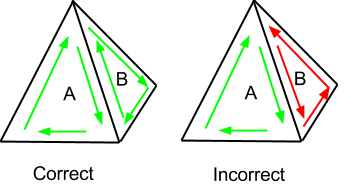
在问题的代码中,面1和面4按逆时针方向排列,面2和面3按顺时针方向排列。简单的修复方法是切换这两个面的第一个和第三个顶点。
face_vhandles.clear();
face_vhandles.push_back(vhandle[3]);
face_vhandles.push_back(vhandle[1]);
face_vhandles.push_back(vhandle[0]);
tin.add_face(face_vhandles);

face_vhandles.clear();
face_vhandles.push_back(vhandle[2]);
face_vhandles.push_back(vhandle[3]);
face_vhandles.push_back(vhandle[0]);
tin.add_face(face_vhandles);Stack Overflow用户
发布于 2021-06-04 09:14:31
为了扩展Cecilia的回答,如果您正在处理生成的数据,并且无法手动修复三角形的方向,那么我提出了一个固定三角形方向的简短算法:
def calc_transitions(path):
    return ((path[0], path[1]),
            (path[1], path[2]),
            (path[2], path[0]))

def swap_path_match(path1, path2):
    tr1 = calc_transitions(path1)
    tr2 = calc_transitions(path2)

    for t in tr1:
        try:
            loc = tr2.index(t)
            swapped = (path2[(loc+2)%3], path2[(loc+1)%3], path2[loc])
            print('From', path1, ': matched (', t[0], '->', t[1], ') in', path2)
            print('Swapping', path2, 'to', swapped)
            return swapped
        except ValueError:
            continue

    return path2
要使用这一点,只需迭代一遍脸列表:
for i in range(len(mesh)):
    for j in range(i+1, len(mesh)):
        mesh[j] = swap_path_match(mesh[i], mesh[j])
其中‘网格’是一个三元组的列表,例如。
[(1, 2, 3), (2, 3, 4), (4, 3, 5)]在此列表中,第0元素和第1元素具有冲突的边缘,因此它们将被交换为:
[(1, 2, 3), (4, 3, 2), (4, 3, 5)]现在与第一和第二元素之间存在冲突,因此它将被替换为:
[(1, 2, 3), (4, 3, 2), (5, 3, 4)]另一个数字被移到前面的原因只是实现的一个怪癖;如果结果序列是等价的,则没有必要维护原始顺序。
要明确的是,这并不能解决任何边缘连接两个以上三角形的几何图形。
https://stackoverflow.com/questions/24205196
复制相似问题
腾讯云开发者

Copyright © 2013 - 2026 Tencent Cloud. All Rights Reserved. 腾讯云 版权所有
深圳市腾讯计算机系统有限公司 ICP备案/许可证号:粤B2-20090059  粤公网安备44030502008569号
腾讯云计算(北京)有限责任公司 京ICP证150476号 | 京ICP备11018762号