
鱿鱼游戏第7集及模拟
昨晚我看了“鱿鱼游戏”系列电视剧的第7集。这一集在桥上有一个二项分布的游戏。

具体来说,有16名玩家和一座桥,有18副玻璃(一副纯玻璃和一副安全玻璃),.If,一位玩家碰巧选择了纯玻璃,然后玻璃无法承受播放器的重量,玻璃就断了。下一个玩家的优势是,他/她是从上一个球员的位置开始的,并且继续二项式的search.At,最后的3名球员碰巧通过了桥牌。
所以我想:就像,我口袋里有16欧元,我和p = 1/2玩正面或反面游戏。每次我在头上打赌。如果抛硬币是正面的,那么我赚0,如果是反面,我会损失1欧元。在我的口袋里,打18次头(连续与否)并留下3欧元的概率是多少?
我试图在R中模拟这个问题:
squid_bridge = function(a,n,p) {
  players = a
  while (position > 0 & position < n) {
    jump  =  sample(c(0,1),1,prob=c(1-p,p))
    position = position + jump
  }
  if (position == 0)
    return(1)
  else
    return(0)
}

n = 18
trials = 100000
a = 16
p = 1/2
set.seed(1)
simlist = replicate(trials, squid_bridge(a, n, p))
这似乎不管用。有什么帮助吗?
回答 5
Stack Overflow用户
发布于 2021-10-15 20:45:45
下面是我认为你可以在R中建立游戏模型的方法,第一个版本和你所拥有的相似:猜对的几率是50%,如果猜对了,玩家就会推进一块瓷砖。否则不会,玩家数量减少1。如果玩家数达到0,或者他们前进到最后,游戏结束。在squid_bridge1()中显示了这一点。
squid_bridge1 <- function(players, n, prob) {
  if (players == 0 | n == 18) {
    # All players have died or we have reached the end
    return(players)
  }

  jump <- rbinom(1, 1, prob)

  if (jump == 0) {
    # Player died
    return(squid_bridge1(players - 1, n, prob))
  }

  if (jump == 1 & n < 18) {
    # Player lives and advances 1 space
    return(squid_bridge1(players, n + 1, prob))
  }
}
然而,这并不能准确地描述游戏,因为错误的猜测会给剩下的玩家提供更多的信息。如果玩家选择错误,那么下一次猜错的概率不是50%,而是100%。然而,在这一点之后,正确猜测的概率降低到50%。这可以用另一个参数来解释,以跟踪之前猜测的正确性。
squid_bridge2 <- function(players, n, prob, previous) {
  if (players == 0 | n == 18) {
    # The game ends if there are no players or they have reached the end
    return(players)
  }

  if (previous == 0) {
    # The previous guess was wrong, but now the players know where to go next
    return(squid_bridge2(players, n + 1, prob, previous = 1))
  }

  jump <- rbinom(1, 1, prob)

  if (jump == 0) {
    # Player died
    return(squid_bridge2(players - 1, n, prob, previous = 0))
  }

  if (jump == 1 & n < 18) {
    # Move is correct. Advance 1 space
    return(squid_bridge2(players, n + 1, prob, previous = 1))
  }
}
不过,这是个陷阱。在表演中,这并不是很简单,玩家摔倒的原因不是一个错误的猜测(被推,故意跳,等等)。我不知道这样做的概率有多大,但它很可能很低,比如说10%。
not_stupid <- function() {
  x <- runif(1, 0, 1)
  if (x <= 0.1) {
    return(FALSE)
  } else {
    return(TRUE)
  }
}
因为情绪在每次移动之前就会激增,我们将在每次移动之前测试这一点。
squid_bridge3 <- function(players, n, prob, previous) {
  if (players == 0 | n == 18) {
    # The game is over because there are no players left or they reached the end
    return(players)
  }

  if (previous == 0) {
    # The previous guess was wrong, but now the players know where to go next
    return(squid_bridge3(players, n + 1, prob, previous = 1))
  }

  if (!not_stupid()) {
    return(squid_bridge3(players - 1, n, prob, previous = 1))
  }

  jump <- rbinom(1, 1, prob)

  if (jump == 0) {
    # Player died because of either choosing wrong or a self-inflicted loss
    return(squid_bridge3(players - 1, n, prob, previous = 0))
  }

  if (jump == 1 & n < 18) {
    # Move is correct. Advance 1 space
    return(squid_bridge3(players, n + 1, prob, previous = 1))
  }
}
然后运行一些模拟:
set.seed(123)
trials <- 10000
players <- 16
squid1 <- replicate(trials, squid_bridge1(players, 0, 0.5))
squid2 <- replicate(trials, squid_bridge2(players, 0, 0.5, 1))
squid3 <- replicate(trials, squid_bridge3(16, 0, 0.5, 1))

df <- tibble(squid1 = squid1,
             squid2 = squid2,
             squid3 = squid3) %>%
  pivot_longer(cols = c(squid1, squid2, squid3))

ggplot(data = df,
       aes(x = value)) +
  geom_histogram(bins = 10,
                 binwidth = 1,
                 fill = "cornflowerblue",
                 color = "black") +
  facet_wrap(~name,
             nrow = 3) +
  xlab("# of players to make it to the end") +
  scale_x_continuous(breaks = seq(0, 16, by = 1),
                     labels = seq(0, 16, by = 1))
如下所示,第一种情况严重偏左。由于玩家对每一块瓷砖基本上都是“盲目猜测”的,所以不太可能有谁能做到这一点。然而,在考虑了从错误的猜测中获得的信息后,它的平均值大约在7名玩家左右。由于另一个原因,通过添加一个随机下降的机会,分布会向左倾斜。
第一情况的
- 平均值:1.45第二情况的
- 平均值:第三情况的
- 平均值: 4.99
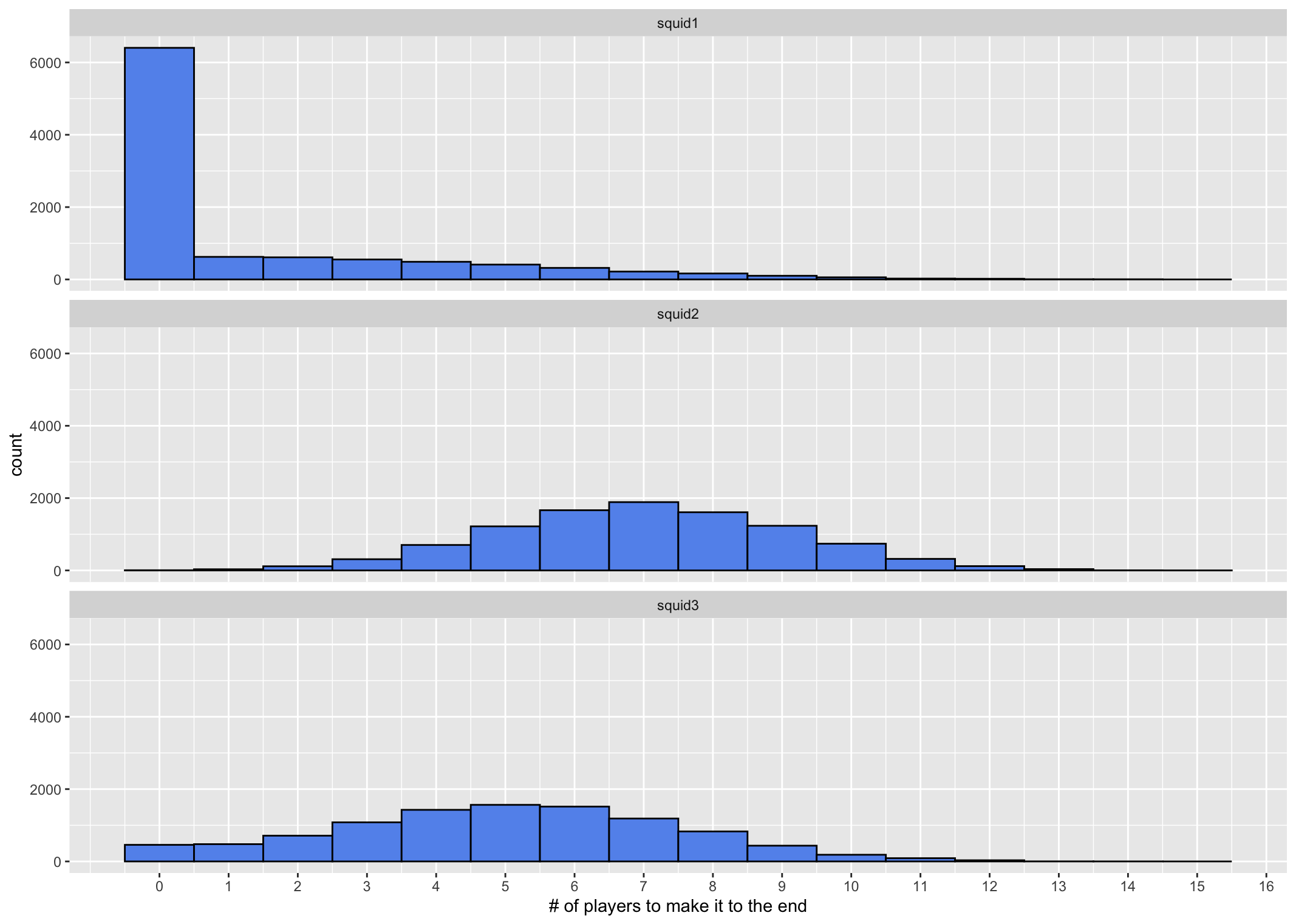
为了回答只有3位玩家的概率问题,最后一种情况下我得到了10.8%的答案。
编辑:根据请求,下面是生成情节的代码。我还修复了存在一些命名问题的各种函数(在创建它们时,我经历了几个不同的名称)。看起来它导致了第三个函数的一个小错误,但我一直在修复它。
Stack Overflow用户
发布于 2021-11-02 13:34:55
这是一个蒙特卡罗实验,在R返回失败次数的分布。
apply(apply(matrix(rgeom(16*1e6,.5)+1,nc=16),1,cumsum)>18,1,mean)
#with details:
#rgeom(16*1e6,.5)+1 for 16 x 10⁶ geometric simulations when
#the outcome is the number of attempts till "success",
# "success" included
#,1,cumsum) for the number of steps till 16th "success"
#)>18 for counting the cases when a player manages to X the bridge
#1,mean) for finding the probability of each of the players to X
这不是二项式,而是截断负二项分布实验,因为每个玩家所做的新步骤的数目是一个几何Geom(1/2)变量,除非这18个步骤已经完成。因此,幸存者的平均人数是
sum(1-pnbinom(size=1:16,q=17:2,prob=.5))
#Explanation:
#pnbinom is the Negative Binomial cdf
#with size the number of "successes"
#q the integer at which the cdf is computed
#prob is the Negative Binomial probability parameter
#Because nbinom() is calibrated as the number of attempts
#before "success", rather than until "success", the value of
#q decreases by one for each player in the game其值为7.000076,而不是16-18/2=7!
Stack Overflow用户
发布于 2021-10-16 21:13:46
0-
##########
# Game ○ △ □
##########
squidd7<-function(N_Fields,N_Players,p_new_field){
  Players<-data.frame(id = 1:N_Players, alive=rep(1,N_Players),Field=0)

    for(i in 1:N_Players){
      while (Players[i,"alive"]==TRUE && max(Players$Field)< N_Fields) {
        Players[i,"Field"]=Players[i,"Field"]+1  # Jump onto the next Field
        Players[i,"alive"]=rbinom(1,1,p_new_field)# Fall or repeat
      }
      Players[i+1,"Field"]=Players[i,"Field"] # next player starts where prior player died
    }
  Players<-Players[1:N_Players,] # cosmetic because i do i+1 in the prior line
  # Print me some messages
  if(!any(Players$alive>0)){
      cat("Players loose!")
    } else {
    cat(" \n After", max(Players$Field),"goal was reached! ")
    cat("Players",Players[Players$alive==1,"id"], "survive")
    }

  return(Players)
}


squidd7(18,16,0.5)

###########
# simulation ○ △ □
###########
results<-data.frame(matrix(0, nrow = 100, ncol = 20))
for(x in 1:ncol(results)){
     for (i in 1:nrow(results)) {
    Players<-squidd7(x+7,16,0.5)
    results[i,x]<-sum(Players$alive)
  }
}
###########
## Results ○○□□○ △ □
sdt<-apply(results,2,sd) # standart devation
mn<-apply(results,2,mean) # ○ △ □

boxplot(results,xlab ="n Steps ",names = 8:27,ylab="N Survivors of 16 ")
points(mn,type="l")
points(sdt,type="l")

colors<-colorRampPalette(c(rgb(0,1,0,0.4),
                           rgb(1,1,0,0.4),
                           rgb(1,0,0,0.4)), alpha = TRUE)(21)


plot(density(results$X1),type="n",xlim=c(-1,17),ylim=c(0,0.30),
     main="○ △ □ ",
     sub="○ △ □ ○ △ □ ○ △ □",
     xlab="number of survivors")
for( i in 1:21){
polygon(density(results[,i]),col= colors[i])
}
legend(15,0.31,title="Steps",legend=8:28,fill=colors,border = NA,
       y.intersp = 0.5,
cex = 0.8, text.font = 0.3)https://stackoverflow.com/questions/69585019
复制相似问题
腾讯云开发者

Copyright © 2013 - 2026 Tencent Cloud. All Rights Reserved. 腾讯云 版权所有
深圳市腾讯计算机系统有限公司 ICP备案/许可证号:粤B2-20090059  粤公网安备44030502008569号
腾讯云计算(北京)有限责任公司 京ICP证150476号 | 京ICP备11018762号