
将对象数组转换为按值分组的数组
将对象数组转换为按值分组的数组
提问于 2020-03-03 03:32:12
在fabric.js应用程序中,我的元素被分成几个组。
用户可以形成包含任意数量的元素的任意数量的组。
所附图像显示分组为三组的元素,每个元素显示其ID。
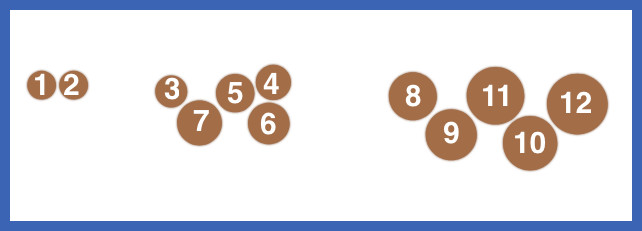
当用户完成创建组时,应用程序测量元素之间的距离,并将元素置于“父-子(Ren)”关系中。
这将产生一个对象数组:
var elements = [
    { "parent": 1, "children": [ 2 ] },
    { "parent": 2, "children": [ 1 ] },
    { "parent": 3, "children": [ 7 ] },
    { "parent": 4, "children": [ 5, 6 ] },
    { "parent": 5, "children": [ 4, 6, 7 ] },
    { "parent": 6, "children": [ 4, 5 ] },
    { "parent": 7, "children": [ 3, 5 ] },
    { "parent": 8, "children": [ 9 ] },
    { "parent": 9, "children": [ 8, 11 ] },
    { "parent": 10, "children": [ 11, 12 ] },
    { "parent": 11, "children": [ 9, 10 ] },
    { "parent": 12, "children": [ 10 ] }
];
组中的每个元素都是接近它的元素的父元素,但同时它也是最接近它的元素的子元素。
在本例中,如何从“元素”数组中获得一个具有三个子数组的数组?
每个生成的子数组都应该包含仅在该组中的元素的ID。
最后的结果应该是:
var groups = [
    [1, 2],
    [3, 4, 5, 6, 7],
    [8, 9, 10, 11, 12]
];回答 2
Stack Overflow用户
回答已采纳
发布于 2020-03-03 06:14:08
1)通过遍历元素来构建集合。对于每个元素,请检查父元素是否位于任何现有集合中。如果没有可用的集合,则创建该集。把孩子们加到片场里。
2)现在,我们有一组集合,可能有交叉集,需要合并。
3)将集合数组转换为数组数组。
PS:我认为合并的第2步可以合并到步骤1中。
var elements = [
  { parent: 1, children: [2] },
  { parent: 2, children: [1] },
  { parent: 3, children: [7] },
  { parent: 4, children: [5, 6] },
  { parent: 5, children: [4, 6, 7] },
  { parent: 6, children: [4, 5] },
  { parent: 7, children: [3, 5] },
  { parent: 8, children: [9] },
  { parent: 9, children: [8, 11] },
  { parent: 10, children: [11, 12] },
  { parent: 11, children: [9, 10] },
  { parent: 12, children: [10] }
];

const arrSets = [];

elements.forEach(({ parent, children }) => {
  let set = arrSets.find(set => set.has(parent));
  if (!set) {
    set = new Set();
    set.add(parent);
    arrSets.push(set);
  }
  children.forEach(x => set.add(x));
});

const resSets = [];
arrSets.forEach(set => {
  let curr = resSets.find(dat => [...set].some(x => dat.has(x)));
  if (!curr) {
    curr = new Set();
    resSets.push(curr);
  }
  [...set].forEach(x => curr.add(x));
});

const arr = resSets.map(set => [...set]);

console.log(arr);
Stack Overflow用户
发布于 2020-03-20 10:00:10
下面是另一种使用堆栈解决问题的方法。
- 从父级开始,遍历其子级和其子级,直到堆栈为空。这是一个group.
- Maintain,一个已访问的数组,以避免循环
- 将组推到主数组(如果不是空的
)
function findGrops(elements) {
  const eleMap = {};
  // build a parent => children map
  elements.forEach( e => {
    eleMap[e.parent] = e.children;
  });

  const groups = [];
  const visited = {};

  // iterate in a depth first way
  // parent -> children -> their children until empty
  Object.keys(eleMap).forEach( k => {
    let grp = [];
    let stk = [k]; //parseInt(k,10) to avoid the quotes
    while( stk.length > 0) {
      let x = stk.pop();
      if (!(x in visited)) {
        grp.push(x);
        visited[x] = true;
        // add children to the stack
        stk = stk.concat(eleMap[x]);
      }
    }
    // push to groups array
    grp.length && groups.push(grp);
  });

  return groups;
}

const input = [
    { "parent": 1, "children": [ 2 ] },
    { "parent": 2, "children": [ 1 ] },
    { "parent": 3, "children": [ 7 ] },
    { "parent": 4, "children": [ 5, 6 ] },
    { "parent": 5, "children": [ 4, 6, 7 ] },
    { "parent": 6, "children": [ 4, 5 ] },
    { "parent": 7, "children": [ 3, 5 ] },
    { "parent": 8, "children": [ 9 ] },
    { "parent": 9, "children": [ 8, 11 ] },
    { "parent": 10, "children": [ 11, 12 ] },
    { "parent": 11, "children": [ 9, 10 ] },
    { "parent": 12, "children": [ 10 ] }
];

  console.log('result:', findGrops(input));
页面原文内容由Stack Overflow提供。腾讯云小微IT领域专用引擎提供翻译支持
原文链接:
https://stackoverflow.com/questions/60499687
复制相关文章
相似问题
腾讯云开发者

Copyright © 2013 - 2026 Tencent Cloud. All Rights Reserved. 腾讯云 版权所有
深圳市腾讯计算机系统有限公司 ICP备案/许可证号:粤B2-20090059  粤公网安备44030502008569号
腾讯云计算(北京)有限责任公司 京ICP证150476号 | 京ICP备11018762号