
如何在C中显示链接列表?
#include <stdio.h>
#include <malloc.h>
struct node
{
    int ID;
    char Name;
    char Pos;
    struct node*next;
};

struct node *start = NULL;
struct node *createList(struct node*);
struct node *displayList(struct node *);

int main()
{
    start=createList(start);
    start = displayList(start);
    return 0;
}

struct node *createList(struct node *start)

{
    struct node *new_node, *ptr;
    int EmpID;
    char EmpName;
    char EmpPos;
    int choice;
    printf("\n Enter the Employee's ID: ");
    scanf("%d", &EmpID);
    printf("\n Enter the Employee's Name: ");
    scanf("%s", &EmpName);
    printf("\n Enter the Employee's Position: ");
    scanf("%s", &EmpPos);
    printf("\n Do you want to add more Employees [Press Any Number Key if 'yes', Press 1 for 'No']: ");
    scanf("%d", &choice);
    while (choice != 1)
    {
        new_node = (struct node *) malloc(sizeof(struct node));
        new_node ->ID=EmpID;
        new_node ->Name =EmpName;
        new_node ->Pos =EmpPos;
        if (start==NULL)
        {
            new_node -> next= NULL;
            start = new_node;
        }
        else
        {
            ptr=start;
            while(ptr->next != NULL)
            {
                 ptr = ptr->next;
            }
            ptr->next = new_node;
            new_node -> next =NULL;

        }
        printf("\n Enter the Employee's ID: ");
        scanf("%d", &EmpID);
        printf("\n Enter the Employee's Name: ");
        scanf("%s", &EmpName);
        printf("\n Enter the Employee's Position: ");
        scanf("%s", &EmpPos);
        printf("\n Do you want to add more Employees [Press Any Number Key if 'yes', Press 1 for 'No']: ");
        scanf("%d", &choice);
    }
    return start;
};

struct node *displayList(struct node *start)
{
    struct node *ptr;
    ptr = start;
    while(ptr !=NULL)
    {
        printf("\t\n Employee's ID: ","%d, ", ptr->ID);
         ptr = ptr->next;
        printf("\t\n Employee's Name: ","%s, ", ptr->Name);
         ptr = ptr->next;
        printf("\t\n Employee's Position: ","%s, ", ptr->Pos);
        ptr = ptr->next;
    }
};
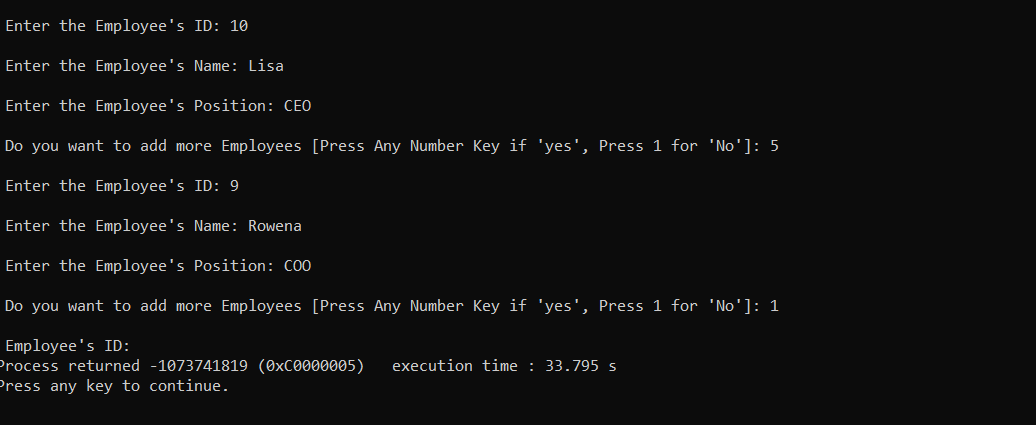
即使没有错误,我的代码也不会显示链接。如何显示?我的预期输出应该是这样的:
输入员工ID: 10
输入员工姓名: Lisa
输入员工职位:首席执行官
是否要添加更多员工按任意数字键(如果‘是’),按1表示'No':5
输入员工ID: 9
输入员工姓名: Rowena
输入员工职位:首席运营官
是否要添加更多员工按任意数字键(如果“是”),按1表示“否”:1
雇员身份证: 10,9
雇员姓名: Lisa,Rowena
雇员职位:首席执行官,首席运营官
当我按1时,我的代码没有显示任何内容。
回答 1
Stack Overflow用户
发布于 2022-10-25 13:08:09
眼前的问题:
struct node
{
    int ID;
    char Name;        // Can only store *single* characters
    char Pos;         // not strings
    struct node*next;
};按照定义,Name和Pos只能存储单个字符,而不能存储字符串--您必须将这些字符定义为char数组
#define MAX_NAME_LEN 20 // or however long a name can be
#define MAX_POS_LEN  20 // or however long a pos can be

struct node {
  int ID;
  char Name[MAX_NAME_LEN + 1]; // +1 for string terminator
  char Pos[MAX_POS_LEN + 1];
  struct node *next;
};或者,您必须将它们定义为指向char的指针
struct node {
  int ID;
  char *Name;
  char *Pos;
  struct node *next;
};
并在创建节点时分别为它们分配内存:
// read EmpID, EmpName, EmpPos
...
struct node *n = malloc( sizeof *n );
if ( n )
{
  n->Name = calloc( strlen( EmpName) + 1, sizeof *n->Name );
  if ( n->Name )
     strcpy( n->Name, EmpName );
  else
     // handle allocation failure

  n->Pos  = calloc( strlen( EmpPos ) + 1, sizeof *n->Pos );
  if ( n->Pos )
     strcpy( n->Pos, EmpPos );
  else
     // handle allocation failure
} 输入函数中的EmpName和EmpPos也有相同的问题:
char EmpName;  // EmpName can only store a *single* character
char EmpPos;   // same with EmpPos
...
scanf( "%s", &EmpName );
...
scanf( "%s", &EmpPos );这将不像您预期的那样工作--如果键入像"Smith" for EmpName这样的输入,'S'将被保存到EmpName中,其余的字符将被写入EmpName之外的内存,覆盖其他数据。
对于输入,绝对需要将EmpName和EmpPos声明为char数组。
char EmpName[MAX_NAME_LENGTH+1];
char EmpPos[MAX_POS_LENGTH+1];如果他们需要能够存储空间(比如"John Smith"),那么您就不能在%s中使用scanf --要么使用%[说明符,比如
scanf( "%[^\n]", EmpName ); // read everything up to the newline
//              ^
// +---------- note no & operator here或者,更好的是,完全抛弃scanf,转而使用fgets:
if ( fgets( EmpName, sizeof EmpName, stdin ) )
  // process EmpName
else
// input error在您的displayList函数中,在打印每个元素之后,将推进节点指针:
while(ptr !=NULL)
{
    printf("\t\n Employee's ID: ","%d, ", ptr->ID);
     ptr = ptr->next;
    printf("\t\n Employee's Name: ","%s, ", ptr->Name);
     ptr = ptr->next;
    printf("\t\n Employee's Position: ","%s, ", ptr->Pos);
    ptr = ptr->next;
}IOW,您打印的是第一个节点的ID,然后是第二个节点的Name,然后是第三个节点的Pos。相反,它应该是:
while(ptr !=NULL)
{
    printf("\t\n Employee's ID: ","%d, ", ptr->ID);
    printf("\t\n Employee's Name: ","%s, ", ptr->Name);
    printf("\t\n Employee's Position: ","%s, ", ptr->Pos);
    ptr = ptr->next;
}我还认为您有您的\t和\n向后-您将打印一个选项卡,然后是一个换行符,所以每个项目将打印在一行的开头。如果这是您想要的,那么您可以完全放弃\t,它并没有真正添加任何东西。如果您希望每一项都由一个制表符插入,则需要反转它们- \n\t。
最好将I/O函数编写为在单个节点上操作,而不是整个列表:
void displayNode( struct node *n )
{
  printf( "\tEmployee ID:       %d\n", n->ID );
  printf( "\tEmployee Name:     %s\n", n->Name );
  printf( "\tEmployee Position: %s\n", n->Pos );
}
并从迭代列表的函数中调用它:
void displayList( struct node *head )
{
  for ( struct node *cur = head; cur != NULL; cur = cur->next )
    displayNode( cur );
}
同样,将输入、节点创建和节点插入拆分为单独的函数:
struct node *head = NULL;

int EmpId;
char EmpName[MAX_NAME_LEN + 1];
char EmpPos[MAX_POS_LEN + 1];

while ( !done )
{
  if ( getNodeData( &EmpId, EmpName, sizeof EmpName, EmpPos, sizeof EmpPos ) )
  {
    struct node *n = createNode( EmpId, EmpName, EmpPos );
    if ( n )
    {
      insertList( &head, n );
    }
    else
    {
      // handle allocation error
      done = true;
    }
  }
  else
  {
    // handle input error
    done = true;
  }

  if ( !done )
  {
    fputs( "Add another node? [Y/N]: ", stdout );
    int c = getchar();
    done = toupper( c ) == 'Y';
  }
}在那里getNodeData看起来像
bool getNodeData( int *id, char *name, size_t nameSize, char *pos, size_t posSize )
{
  fputs( "Enter employee ID: ", stdout );
  if ( scanf( "%d", id ) != 1 )
  {
    fputs( "Error reading emp ID\n", stderr );
    return false;
  }

  fputs( "Enter employee name: ", stdout );
  if ( !fgets( name, nameSize, stdin ) )
  {
    fputs( "Error reading Emp Name\n", stderr );
    return false;
  }

  fputs( "Enter employee position: ", stdout );
  if ( !fgets( pos, posSize, stdin ) )
  {
    fputs( "Error reading Emp Position\n", stderr );
    return false;
  }
  return true;
}createNode看起来就像
struct node *createNode( int id, const char *name, const char *pos )
{
  struct node *n = calloc( 1, sizeof *n );
  if ( n )
  {
    n->Name = calloc( strlen( name ) + 1, sizeof *n->Name );
    if ( !n->Name )
    {
      fputs( "Allocation failure on n->Name!\n", stderr );
      free( n );
      n = NULL;
    }
    else
      strcpy( n->Name, name );

    n->Pos = calloc( strlen( n->Pos ) + 1, sizeof *n->Pos );
    if ( !n->Pos )
    {
      fputs( "Allocation failure on n->Pos!\n", stderr );
      free( n->Name );
      free( n );
      n = NULL;
    }
    else
    {
      strcpy( n->Pos, pos );
    }
  }
  return n;
}insertList看起来就像
void insertList( struct node **head, struct node *n )
{
  if ( !*head )
    *head = n;
  else
  {
    struct node *cur = *head;
    while ( cur->next != NULL )
      cur = cur->next;
    cur->next = n;
  }
}
这使您可以隔离地测试每一段代码,并使通过推理和修复代码变得更加容易。
https://stackoverflow.com/questions/74193067
复制相似问题
腾讯云开发者

Copyright © 2013 - 2026 Tencent Cloud. All Rights Reserved. 腾讯云 版权所有
深圳市腾讯计算机系统有限公司 ICP备案/许可证号:粤B2-20090059  粤公网安备44030502008569号
腾讯云计算(北京)有限责任公司 京ICP证150476号 | 京ICP备11018762号