
尽可能有效地在矩阵中找到序列
几个需求.
在发帖之前请先回答!
1)确保您的函数不会给其他数据带来错误,模拟几个类似的矩阵。(关掉种子)
2)确保您的功能比我的更快
3)确保您的函数与我的完全相同,在不同的矩阵上模拟它(关闭种子)
例如
 for(i in 1:500){
    m <- matrix(sample(c(F,T),30,T),ncol = 3) ; colnames(m) <- paste0("x",1:ncol(m))

    res <- c(my_fun(m),your_function(m))
    print(res)
    if(sum(res)==1)  break
    }
m4)该函数应该使用任意数量的行和列的矩阵。
==========================================================函数在逻辑矩阵的第一列中查找true,如果找到真,则转到第2列和新行,等等。如果找到序列true false,则返回(如果没有)
set.seed(15)
m <- matrix(sample(c(F,T),30,T),ncol = 3) ; colnames(m) <- paste0("x",1:ncol(m))
m
         x1    x2    x3
 [1,] FALSE  TRUE  TRUE
 [2,] FALSE FALSE FALSE
 [3,]  TRUE  TRUE  TRUE
 [4,]  TRUE  TRUE  TRUE
 [5,] FALSE FALSE FALSE
 [6,]  TRUE  TRUE FALSE
 [7,] FALSE  TRUE FALSE
 [8,] FALSE FALSE FALSE
 [9,] FALSE FALSE  TRUE
[10,] FALSE FALSE  TRUE
我的慢示例函数
find_seq <- function(m){
colum <- 1
res <- rep(FALSE,ncol(m))
for(i in 1:nrow(m)){
    if(m[i,colum]==TRUE){
      res[colum] <- TRUE
      print(c(row=i,col=colum))
      colum <- colum+1}
  if(colum>ncol(m)) break
}

 all(res)
}
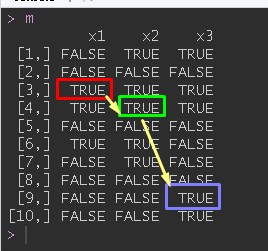
find_seq(m)
row col
  3   1
row col
  4   2
row col
  9   3
[1] TRUE
如何使它尽可能快?
UPD=========================
 microbenchmark::microbenchmark(Jean_Claude_Arbaut_fun(m),
+                                ThomasIsCoding_fun(m),
+                                my_fun(m))
Unit: microseconds
                      expr    min     lq     mean  median      uq     max neval cld
 Jean_Claude_Arbaut_fun(m)  2.850  3.421  4.36179  3.9915  4.5615  27.938   100 a
     ThomasIsCoding_fun(m) 14.824 15.965 17.92030 16.5350 17.1050 101.489   100  b
my_fun(m) 23.946 24.517 25.59461 25.0880 25.6580 42.192 100 c回答 6
Stack Overflow用户
发布于 2022-04-07 12:12:38
如果我正确地理解了这个问题,那么一个通过行的循环就足够了。下面是一种使用Rcpp实现此操作的方法。这里我只返回真假答案,如果你需要索引,它也是可行的。
library(Rcpp)

cppFunction('
bool hasSequence(LogicalMatrix m) {
  int nrow = m.nrow(), ncol = m.ncol();

  if (nrow > 0 && ncol > 0) {
    int j = 0;
    for (int i = 0; i < nrow; i++) {
      if (m(i, j)) {
        if (++j >= ncol) {
          return true;
        }
      }
    }
  }
  return false;
}')


a <- matrix(c(F, F, T, T, F, T, F, F, F, F,
              T, F, T, T, F, T, T, F, F, F,
              T, F, T, T, F, F, F, F, T, T), ncol = 3)

a
hasSequence(a)
为了获得索引,下面的函数返回一个列表,其中至少有一个元素(名为' found‘、true或false),如果found= true,则返回另一个名为’indices‘的元素:
cppFunction('
List findSequence(LogicalMatrix m) {
  int nrow = m.nrow(), ncol = m.ncol();

  IntegerVector indices(ncol);
  if (nrow > 0 && ncol > 0) {
    int j = 0;
    for (int i = 0; i < nrow; i++) {
      if (m(i, j)) {
        indices(j) = i + 1;
        if (++j >= ncol) {
          return List::create(Named("found") = true,
                              Named("indices") = indices);
        }
      }
    }
  }
  return List::create(Named("found") = false);
}')

findSequence(a)
了解Rcpp的几个链接:
- 使用Rcpp的高性能功能,Hadley Wickham
- 每个人的Rcpp,Masaki E. Tsuda
- R与C/C++的接口,Matteo
- Rcpp画廊 - Rcpp包的文章和代码示例
您必须至少了解一点C语言(最好是C++,但对于基本用法来说,您可以将Rcpp视为C,并为R数据类型提供一些神奇的语法)。第一个链接解释了Rcpp类型的基本知识(向量、矩阵和列表,以及如何分配、使用和返回它们)。其他环节是很好的补充。
Stack Overflow用户
发布于 2022-04-07 08:28:56
更新
如果您正在追求速度,您可以尝试下面的基本R解决方案
TIC_fun <- function(m) {
    p <- k <- 1
    nr <- nrow(m)
    nc <- ncol(m)
    repeat {
        if (p > nr) {
            return(FALSE)
        }
        found <- FALSE
        for (i in p:nr) {
            if (m[i, k]) {
                # print(c(row = i, col = k))
                p <- i + 1
                k <- k + 1
                found <- TRUE
                break
            }
        }
        if (!found) {
            return(FALSE)
        }
        if (k > nc) {
            return(TRUE)
        }
    }
}
你会看到
Unit: microseconds
       expr    min      lq      mean  median      uq       max neval
  my_fun(m) 18.600 26.3010  41.46795 41.5510 44.3010   121.302   100
 TIC_fun(m) 10.201 14.1515 409.89394 22.6505 24.4005 38906.601   100
先前的回答
您可以尝试下面的代码
lst <- with(as.data.frame(which(m, arr.ind = TRUE)), split(row, col))
# lst <- apply(m, 2, which)

setNames(
    stack(
        setNames(
            Reduce(function(x, y) y[y > x][1],
                lst,
                init = -Inf,
                accumulate = TRUE
            )[-1],
            names(lst)
        )
    ),
    c("row", "col")
)
这给
  row col
1   3   1
2   4   2
3 9 3一个更有趣的实现可能是使用递归(只是为了好玩,而不是因为效率低下而重新命令)。
f <- function(k) {
    if (k == 1) {
        return(data.frame(row = which(m[, k])[1], col = k))
    }
    s <- f(k - 1)
    for (i in (tail(s, 1)$row + 1):nrow(m)) {
        if (m[i, k]) {
            return(rbind(s, data.frame(row = i, col = k)))
        }
    }
}
这给了
> f(ncol(m))
  row col
1   3   1
2   4   2
3 9 3Stack Overflow用户
发布于 2022-04-07 10:06:50
如果您的例子具有代表性,我们假设是nrow(m) >> ncol(m)。在这种情况下,将interation从行移动到列将更有效:
ff = function(m)
{
  i1 = 1
  for(j in 1:ncol(m)) {
    if(i1 > nrow(m)) return(FALSE)
    i1 = match(TRUE, m[i1:nrow(m), j]) + i1
    #print(i1)
    if(is.na(i1)) return(FALSE)
  }
  return(TRUE)
}https://stackoverflow.com/questions/71778612
复制相似问题
腾讯云开发者

Copyright © 2013 - 2026 Tencent Cloud. All Rights Reserved. 腾讯云 版权所有
深圳市腾讯计算机系统有限公司 ICP备案/许可证号:粤B2-20090059  粤公网安备44030502008569号
腾讯云计算(北京)有限责任公司 京ICP证150476号 | 京ICP备11018762号