2026-06-12:打家劫舍 V。用go语言,你现在要处理一个“相邻房屋不能同色同时偷”的求最大收益问题: - 有 n 间沿街房屋,第 i 间房屋里

2026-06-12:打家劫舍 V。用go语言,你现在要处理一个“相邻房屋不能同色同时偷”的求最大收益问题: - 有 n 间沿街房屋,第 i 间房屋里

福大大架构师每日一题
发布于 2026-06-12 18:10:05
发布于 2026-06-12 18:10:05
2026-06-12:打家劫舍 V。用go语言,你现在要处理一个“相邻房屋不能同色同时偷”的求最大收益问题:
- • 有 n 间沿街房屋,第 i 间房屋里有 nums[i] 金额。
- • 每间房屋还有一个颜色代码 colors[i]。
- • 规则是:如果两间房屋相邻(下标 i 和 i+1)且它们的颜色代码相同,那么这两间不能同时被偷。
- • 在满足上述限制的前提下,选择要偷的房屋,使得获得的总金额最大。
- • 请输出在最优选择下能得到的最大总金额。
1 <= n == nums.length == colors.length <= 100000。
1 <= nums[i], colors[i] <= 100000。
输入: nums = [10,1,3,9], colors = [1,1,1,2]。
输出: 22。
解释:
选择第 i = 0 间房屋(金额为 10)、第 i = 2 间房屋(金额为 3)和第 i = 3 间房屋(金额为 9)。
此选择是合法的,因为第 i = 0 和 i = 2 间房屋不相邻,且第 i = 2 和 i = 3 间房屋颜色不同。
因此,偷窃的总金额为 10 + 3 + 9 = 22。
题目来自力扣3840。
一、逐轮分步演算完整流程(以示例nums=[10,1,3,9]、colors=[1,1,1,2]为例)
初始化阶段(i=0,第一间房屋)
房屋0:金额10,颜色1
- • 数组长度不为0,跳过边界返回0逻辑
- • f1初始化为0:不偷0号房,收益0
- • f2初始化为10:偷0号房,收益10 当前状态:f1=0(不偷0),f2=10(偷0)
第一轮循环:i=1(第二间房屋,金额1,颜色1)
对比相邻颜色:colors[1]=1,colors[0]=1,相邻同色,触发同色分支逻辑。 规则:i和i-1同色,不能同时偷i和i-1,因此偷当前i的方案只能来自「不偷i-1的收益f1 + 当前房屋金额」,再和「不偷当前i,保留偷i-1的收益f2」取更大值作为money。
- 1. 候选1(偷1号房):f1 + nums[1] = 0 + 1 = 1
- 2. 候选2(不偷1号房):f2 = 10
- 3. 二者取大,money = max(1,10) = 10
- 4. 滚动更新状态: f1 = 旧f2 = 10(现在f1代表不偷1号房的最大收益) f2 = money = 10(现在f2代表偷1号房的最大收益) 本轮结束状态:f1=10,f2=10
第二轮循环:i=2(第三间房屋,金额3,颜色1)
对比相邻颜色:colors[2]=1,colors[1]=1,相邻同色,再次进入同色分支。
- 1. 候选1(偷2号房):f1 + nums[2] = 10 + 3 = 13
- 2. 候选2(不偷2号房):f2 = 10
- 3. 二者取大,money = max(13,10) = 13
- 4. 滚动更新状态: f1 = 旧f2 = 10(不偷2号房最大收益) f2 = money = 13(偷2号房最大收益) 本轮结束状态:f1=10,f2=13 解读:此时偷2号房最优收益13,对应方案是不偷1号、偷0号+偷2号(10+3=13),和题目最优方案中间步骤匹配。
第三轮循环:i=3(第四间房屋,金额9,颜色2)
对比相邻颜色:colors[3]=2,colors[2]=1,相邻异色,进入异色分支逻辑。 规则:i和i-1颜色不同,无偷窃冲突,可以同时偷i-1和i,因此偷当前i的收益 = 偷i-1的最大收益f2 + 当前房屋金额,直接赋值给money。
- 1. money = f2 + nums[3] = 13 + 9 = 22
- 2. 滚动更新状态: f1 = 旧f2 = 13(不偷3号房的最大收益) f2 = money = 22(偷3号房的最大收益) 本轮结束状态:f1=13,f2=22
循环结束,返回结果
循环遍历完所有4间房屋,最终f2存储遍历到最后一间房屋、偷最后一间时的全局最大收益,返回22,和题目输出一致。
二、通用算法完整逻辑步骤(脱离示例,通用处理任意n间房屋)
步骤1:边界判断
如果房屋总数n=0,不存在可偷窃房屋,直接返回总收益0。
步骤2:DP状态初始化(处理第0号首间房屋)
- • f1:不偷第0间,收益固定为0;
- • f2:偷第0间,收益等于第一间房屋金额nums[0];
步骤3:从第1间到最后一间,依次遍历每一间房屋i(循环i=1 ~ n-1)
每一次循环执行固定三步:
步骤3.1 判断当前i和前一间i-1的颜色关系
分支A:colors[i] != colors[i-1](相邻异色) 相邻异色无偷窃冲突,可以同时偷前一间和当前间。 当前房屋偷窃最优收益money = 偷前一间的最大收益f2 + 当前房屋金额nums[i]
分支B:colors[i] == colors[i-1](相邻同色) 相邻同色不能两间都偷,有两种选择:
- 1. 不偷当前房屋:收益=偷前一间的收益f2;
- 2. 偷当前房屋:只能不偷前一间,收益=不偷前一间的收益f1 + nums[i]; 取两种选择里数值更大的作为money。
步骤3.2 滚动更新DP状态变量
完成money计算后,刷新两个状态变量,为下一间房屋遍历做准备:
- 1. f1 赋值为原来的f2:下一轮中,f1代表「不偷当前i号房」的最大收益;
- 2. f2 赋值为本轮算出的money:下一轮中,f2代表「偷当前i号房」的最大收益。
步骤4:遍历全部房屋后输出结果
循环结束后,f2保存的是遍历到最后一间房屋、包含偷最后一间方案的全局最大总金额,直接返回f2作为答案。
三、时间复杂度、额外空间复杂度分析
1. 时间复杂度 O(n)
n为房屋总数,算法仅执行一次单层for循环,循环执行次数恰好n-1次; 循环内部仅包含颜色比较、简单四则运算、大小比较,所有操作都是常数时间O(1); 无嵌套循环、无排序、无递归,整体时间复杂度线性O(n),可以满足题目n≤100000的数据规模。
2. 额外空间复杂度 O(1)
输入的nums、colors属于题目给定输入数组,不计入算法额外空间; 算法内部仅永久开辟3个固定变量:f1、f2、money,变量数量不随房屋数量n变化; 没有创建DP数组、切片、哈希表等随n扩容的数据结构; 仅使用常数级临时存储空间,额外空间复杂度为O(1)。
Go完整代码如下:
.
package main

import (
    "fmt"
)

func rob(nums []int, colors []int)int64 {
    iflen(nums) == 0 {
        return0
    }
    f1 := int64(0)
    f2 := int64(nums[0])
    n := len(nums)
    for i := 1; i < n; i++ {
        var money int64
        if colors[i] != colors[i-1] {
            money = f2 + int64(nums[i])
        } else {
            if f1+int64(nums[i]) > f2 {
                money = f1 + int64(nums[i])
            } else {
                money = f2
            }
        }
        f1 = f2
        f2 = money
    }
    return f2
}

func main() {
    nums := []int{10, 1, 3, 9}
    colors := []int{1, 1, 1, 2}
    result := rob(nums, colors)
    fmt.Println(result)
}
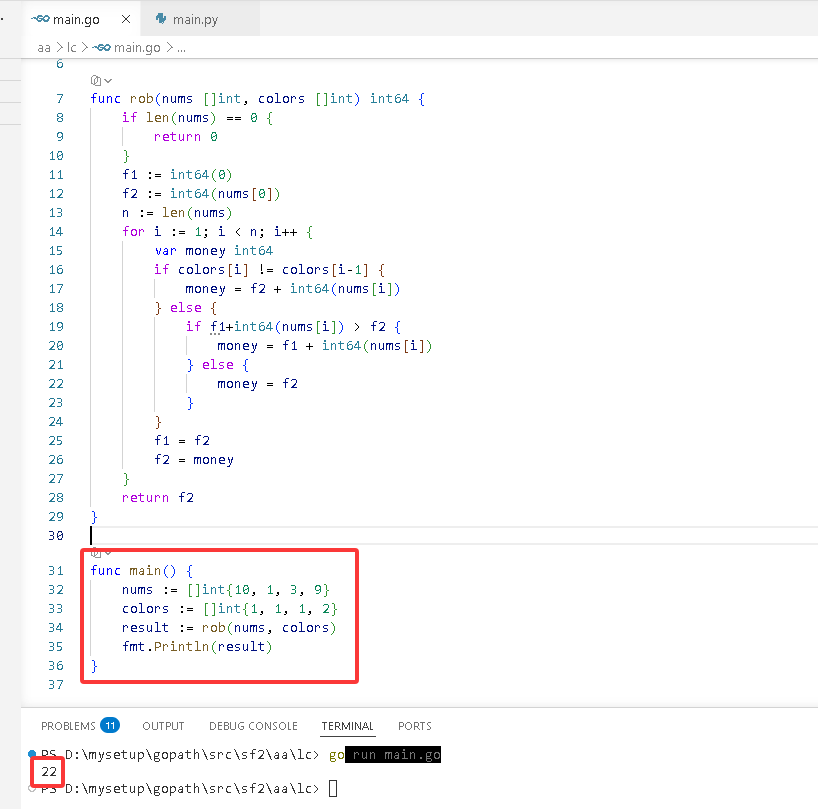
在这里插入图片描述
Python完整代码如下:
.
# -*-coding:utf-8-*-

from typing import List

class Solution:
    def rob(self, nums: List[int], colors: List[int]) -> int:
        iflen(nums) == 0:
            return0
        f1 = 0
        f2 = nums[0]
        n = len(nums)
        for i in range(1, n):
            if colors[i] != colors[i-1]:
                money = f2 + nums[i]
            else:
                money = max(f1 + nums[i], f2)
            f1 = f2
            f2 = money
        return f2


if __name__ == "__main__":
    nums = [10, 1, 3, 9]
    colors = [1, 1, 1, 2]
    result = Solution().rob(nums, colors)
    print(result)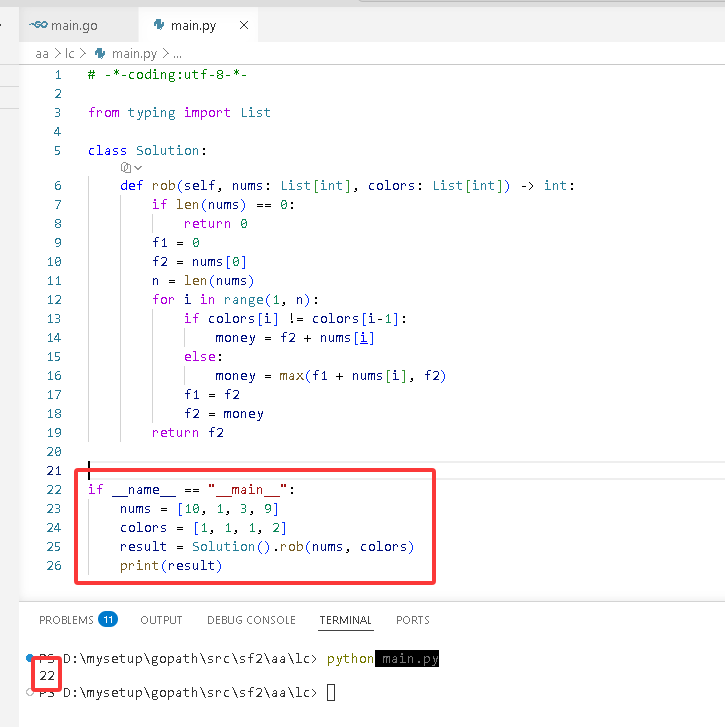
在这里插入图片描述
C++完整代码如下:
.
#include <iostream>
#include <vector>
#include <algorithm>

using namespace std;

long long rob(vector<int>& nums, vector<int>& colors) {
    if (nums.empty()) {
        return0;
    }
    long long f1 = 0;
    long long f2 = nums[0];
    int n = nums.size();
    for (int i = 1; i < n; i++) {
        long long money;
        if (colors[i] != colors[i-1]) {
            money = f2 + nums[i];
        } else {
            money = max(f1 + nums[i], f2);
        }
        f1 = f2;
        f2 = money;
    }
    return f2;
}

int main() {
    vector<int> nums = {10, 1, 3, 9};
    vector<int> colors = {1, 1, 1, 2};
    long long result = rob(nums, colors);
    cout << result << endl;
    return0;
}
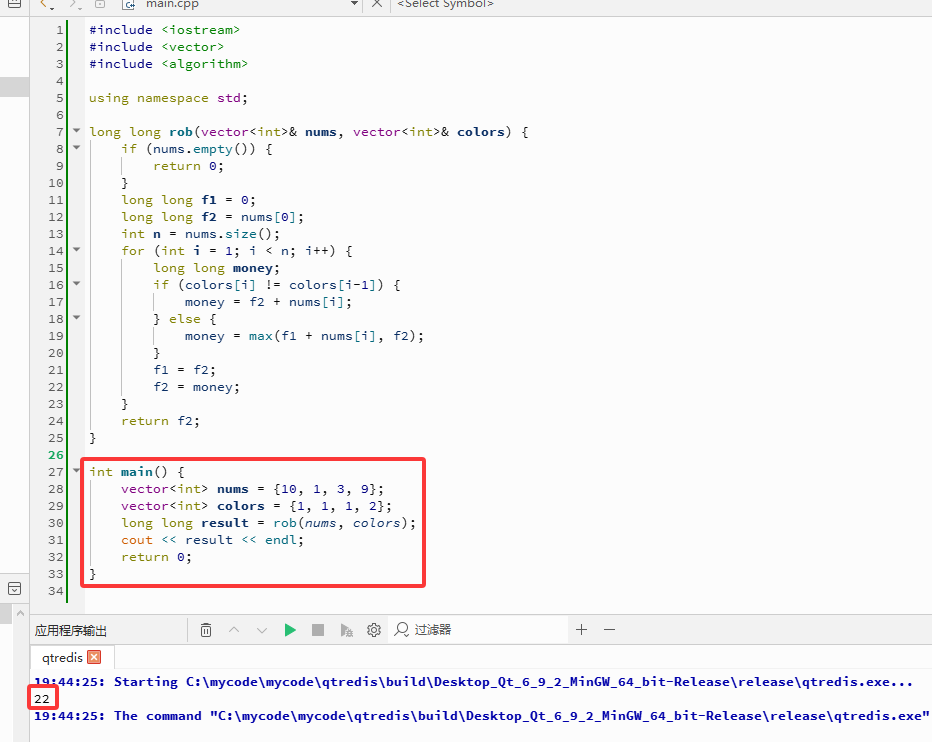
在这里插入图片描述
·
我们相信人工智能为普通人提供了一种“增强工具”,并致力于分享全方位的AI知识。在这里,您可以找到最新的AI科普文章、工具评测、提升效率的秘籍以及行业洞察。
本文参与 腾讯云自媒体同步曝光计划,分享自微信公众号。
原始发表:2026-06-11,如有侵权请联系 cloudcommunity@tencent.com 删除
目录
腾讯云开发者

Copyright © 2013 - 2026 Tencent Cloud. All Rights Reserved. 腾讯云 版权所有
深圳市腾讯计算机系统有限公司 ICP备案/许可证号:粤B2-20090059  粤公网安备44030502008569号
腾讯云计算(北京)有限责任公司 京ICP证150476号 | 京ICP备11018762号