36-Rust 教程 - FFI

36-Rust 教程 - FFI

LarryLan
发布于 2026-06-05 20:27:49
发布于 2026-06-05 20:27:49
FFI
当 Rust 遇上 C:一场跨语言的"相亲",安全与自由的碰撞
🎬 引入
想象一下这个场景:
你是一个 Rust 程序员,代码写得风生水起,内存安全、并发无忧。突然有一天,老板走过来:
"咱们有个老的 C 库,性能特别好,你能不能把它集成到咱们的 Rust 项目里?"
你心里一紧:"Rust 和 C……这俩能玩到一起吗?"
答案是:能!而且玩得还不错!
这就是咱们今天要聊的 FFI(Foreign Function Interface,外部函数接口)。简单说,就是让 Rust 和 C(以及其他语言)能够互相调用对方的代码。
但先别急着高兴。Rust 和 C 就像两个性格迥异的人:
- Rust:严谨、安全、处处检查
- C:自由、奔放、"我说了算"
让它们合作,就像让一个强迫症和一个随性的人一起做饭——需要一些规则和技巧。
今天,咱们就来学习怎么让这两位"握手言和"。
📌 核心概念:FFI 是什么?
FFI 的定义
FFI(Foreign Function Interface)允许一种语言调用另一种语言的函数。在 Rust 中,主要指 Rust 调用 C 或 C 调用 Rust。
为什么需要 FFI?
- 复用现有代码:几十年积累的 C 库,不能扔了吧?
- 性能关键代码:某些底层操作 C 确实更快
- 系统 API:操作系统 API 大多是 C 接口
- 生态互补:某些功能 C 生态更成熟
Rust 和 C 的主要差异
特性 | Rust | C |
|---|---|---|
内存安全 | 编译时保证 | 程序员负责 |
空指针 | Option | NULL 指针 |
字符串 | UTF-8,有长度 | 以\0结尾的字节数组 |
错误处理 | Result<T, E> | 返回值/errno |
命名约定 | snake_case | 各种风格都有 |
关键问题: 这些差异需要在 FFI 边界处进行转换。
💻 代码示例
1. Rust 调用 C 函数
这是最常见的场景。假设我们有一个 C 库:
// math_lib.c
#include <stdint.h>

// 简单的加法函数
int32_t c_add(int32_t a, int32_t b) {
    return a + b;
}

// 字符串处理(注意:C 字符串是\0结尾的)
int c_string_length(const char* str) {
    int len = ;
    while (str[len] != '\0') {
        len++;
    }
    return len;
}
编译成动态库:
# Linux/macOS
gcc -shared -fPIC -o libmath_lib.so math_lib.c

# Windows
gcc -shared -o math_lib.dll math_lib.c
在 Rust 中调用:
// main.rs

// 声明外部函数
extern "C" {
    fn c_add(a: i32, b: i32) -> i32;
    fn c_string_length(str: *const u8) -> i32;
}

fn main() {
    // 调用 C 函数(需要 unsafe!)
    unsafe {
        let result = c_add(, );
        println!("5 + 3 = {}", result);  // 8

        let c_str = b"Hello, C!\0";  // 注意:需要\0结尾
        let len = c_string_length(c_str.as_ptr());
        println!("String length: {}", len);  // 10
    }
}
Cargo.toml 配置:
[build-dependencies]
cc = "1.0"
// build.rs
fn main() {
    cc::Build::new()
        .file("math_lib.c")
        .compile("math_lib");
}
2. C 调用 Rust 函数
反过来,C 也可以调用 Rust 函数。这在给 C 程序提供 Rust 实现的高性能函数时很有用。
// lib.rs

// 使用 #[no_mangle] 防止名字修饰
// 使用 extern "C" 指定 C 调用约定

#[no_mangle]
pub extern "C" fn rust_add(a: i32, b: i32) -> i32 {
    a + b
}

#[no_mangle]
pub extern "C" fn rust_process_string(input: *const u8, len: usize) -> usize {
    unsafe {
        // 将 C 字符串转换为 Rust 字符串
        let slice = std::slice::from_raw_parts(input, len);
        let s = std::str::from_utf8(slice).unwrap_or("");
        s.len()
    }
}
编译成动态库:
# Cargo.toml
[lib]
crate-type = ["cdylib"]
name = "rust_lib"
cargo build --release
在 C 中调用:
// main.c
#include <stdio.h>
#include <stdint.h>

// 声明 Rust 函数
extern int32_t rust_add(int32_t a, int32_t b);
extern size_t rust_process_string(const uint8_t* input, size_t len);

int main() {
    int result = rust_add(, );
    printf("Rust says: 10 + 20 = %d\n", result);  // 30

    const char* str = "Hello from C!";
    size_t len = rust_process_string((const uint8_t*)str, );
    printf("String length: %zu\n", len);

    return ;
}
3. 字符串转换:C 字符串 ↔ Rust 字符串
这是 FFI 中最常见的痛点。C 用 \0 结尾的字节数组,Rust 用 UTF-8 编码的 String/&str。
use std::ffi::{CStr, CString};
use std::os::raw::c_char;

extern "C" {
    fn c_get_message() -> *const c_char;
}

fn main() {
    unsafe {
        // C 字符串 → Rust 字符串
        let c_ptr = c_get_message();

        // 方法 1:使用 CStr(不拥有所有权)
        let c_str = CStr::from_ptr(c_ptr);
        let rust_str = c_str.to_str().unwrap();
        println!("Message: {}", rust_str);

        // Rust 字符串 → C 字符串
        let rust_string = String::from("Hello from Rust!");
        let c_string = CString::new(rust_string).unwrap();
        let c_ptr = c_string.as_ptr();

        // ⚠️ 注意:c_string 不能在这里 drop!
        // 如果 C 函数需要保存指针,需要手动管理内存
    }
}
完整示例:安全的字符串 FFI
use std::ffi::{CStr, CString};
use std::os::raw::c_char;
use std::ptr;

/// 将 Rust 字符串转换为 C 字符串
/// 返回一个裸指针,调用者负责释放
#[no_mangle]
pub extern "C" fn rust_create_string(input: *const c_char) -> *mut c_char {
    unsafe {
        if input.is_null() {
            return ptr::null_mut();
        }

        let c_str = CStr::from_ptr(input);
        let rust_str = c_str.to_str().unwrap_or("");

        // 添加一些 Rust 风格的处理
        let processed = format!("[Rust processed: {}]", rust_str);

        // 转换为 C 字符串并返回指针
        let c_string = CString::new(processed).unwrap();
        c_string.into_raw()  // 释放所有权,返回指针
    }
}

/// 释放由 rust_create_string 创建的字符串
/// ⚠️ 必须由调用者显式调用,否则内存泄漏!
#[no_mangle]
pub extern "C" fn rust_free_string(ptr: *mut c_char) {
    unsafe {
        if !ptr.is_null() {
            let _ = CString::from_raw(ptr);  // 重新获取所有权并 drop
        }
    }
}
4. 结构体互操作
Rust 和 C 的结构体可以互操作,但需要注意内存布局。
// Rust 端
#[repr(C)]// 关键!使用 C 的内存布局
#[derive(Debug, Clone, Copy)]
pub struct Point {
    x: f64,
    y: f64,
}

#[no_mangle]
pub extern "C" fn point_distance(p1: Point, p2: Point) -> f64 {
    let dx = p1.x - p2.x;
    let dy = p1.y - p2.y;
    (dx * dx + dy * dy).sqrt()
}
// C 端
#include <stdio.h>
#include <math.h>

typedef struct {
    double x;
    double y;
} Point;

extern double point_distance(Point p1, Point p2);

int main() {
    Point p1 = {0.0, 0.0};
    Point p2 = {3.0, 4.0};

    double dist = point_distance(p1, p2);
    printf("Distance: %.2f\n", dist);  // 5.00

    return ;
}
⚠️ 重要: #[repr(C)] 是必须的!否则 Rust 可能优化内存布局,导致 C 端读取错误。
5. 错误处理:Result ↔ errno
Rust 用 Result<T, E>,C 用返回值 + errno。怎么转换?
use std::io::{self, ErrorKind};
use std::os::raw::c_int;

#[no_mangle]
pub extern "C" fn safe_divide(a: i32, b: i32, result: *mut i32) -> c_int {
    if b ==  {
        // 设置 errno(需要 libc crate)
        unsafe {
            *libc::__errno_location() = libc::EDOM;
        }
        return -;  // 错误
    }

    unsafe {
        *result = a / b;
    }
    // 成功
}

// 更 Rust 风格的封装
pub fn divide(a: i32, b: i32) -> io::Result<i32> {
    let mut result: i32 = ;
    let ret = unsafe {
        safe_divide(a, b, &mut result)
    };

    if ret ==  {
        Ok(result)
    } else {
        Err(io::Error::new(
            ErrorKind::InvalidInput,
            "Division by zero"
        ))
    }
}
🐛 常见坑点
坑点 1:忘记 #[repr(C)]
// ❌ 错误:没有指定内存布局
struct Data {
    a: i32,
    b: u8,
    c: i32,
}

// ✅ 正确:使用 C 兼容布局
#[repr(C)]
struct Data {
    a: i32,
    b: u8,
    c: i32,
}
后果: Rust 可能重新排列字段顺序,C 端读取的数据全乱了。
坑点 2:字符串没有\0结尾
// ❌ 错误:忘记\0
let c_str = b"Hello";  // C 端会读取到垃圾数据

// ✅ 正确:添加\0
let c_str = b"Hello\0";
// 或者用 CString
let c_string = CString::new("Hello").unwrap();
坑点 3:内存泄漏
#[no_mangle]
pub extern "C" fn create_string() -> *mut u8 {
    let s = String::from("Hello");
    s.as_ptr() as *mut u8// ❌ 错误:s 会被 drop,指针失效!
}

// ✅ 正确:转移所有权
#[no_mangle]
pub extern "C" fn create_string() -> *mut u8 {
    let s = String::from("Hello");
    CString::new(s).unwrap().into_raw() as *mut u8
}

// 并且提供释放函数
#[no_mangle]
pub extern "C" fn free_string(ptr: *mut u8) {
    unsafe {
        if !ptr.is_null() {
            let _ = CString::from_raw(ptr as *mut c_char);
        }
    }
}
坑点 4:线程安全问题
static mut COUNTER: i32 = ;

#[no_mangle]
pub extern "C" fn increment() {
    unsafe {
        COUNTER += ;  // ❌ 数据竞争!
    }
}
解决: 使用 AtomicI32 或 Mutex。
🎯 实战案例:封装 SQLite C 库
让我们看一个真实的 FFI 封装案例——封装 SQLite 的 C API:
use std::ffi::{CStr, CString};
use std::os::raw::{c_char, c_int};
use std::ptr;

// 声明 SQLite 的 C 函数
#[link(name = "sqlite3")]
extern "C" {
    fn sqlite3_open(filename: *const c_char, db: *mut *mut Sqlite3Db) -> c_int;
    fn sqlite3_close(db: *mut Sqlite3Db) -> c_int;
    fn sqlite3_errmsg(db: *mut Sqlite3Db) -> *const c_char;
}

#[repr(C)]
struct Sqlite3Db {
    // 不透明指针,我们不需要知道内部结构
    _private: [u8; ],
}

// 安全的 Rust 封装
pub struct Database {
    db: *mut Sqlite3Db,
}

impl Database {
    pub fn open(path: &str) -> Result<Self, String> {
        let c_path = CString::new(path).unwrap();
        let mut db: *mut Sqlite3Db = ptr::null_mut();

        unsafe {
            let result = sqlite3_open(c_path.as_ptr(), &mut db);
            if result !=  {
                let errmsg = sqlite3_errmsg(db);
                let msg = CStr::from_ptr(errmsg).to_string_lossy().into_owned();
                return Err(msg);
            }
        }

        Ok(Database { db })
    }
}

impl Drop for Database {
    fn drop(&mut self) {
        unsafe {
            if !self.db.is_null() {
                sqlite3_close(self.db);
            }
        }
    }
}

// 实现 Send 和 Sync(SQLite 连接在特定条件下是线程安全的)
unsafe impl Send for Database {}
unsafe impl Sync for Database {}

fn main() {
    let db = Database::open("test.db").unwrap();
    println!("Database opened successfully!");
    // db 会自动关闭(Drop trait)
}
这个例子展示了:
- 使用
#[link]链接外部库 - 不透明指针(opaque pointer)隐藏 C 结构体细节
- 安全的 Rust 封装(RAII 模式)
- 正确的资源清理(Drop trait)
- 实现 Send/Sync(谨慎!)
🧠 思维导图
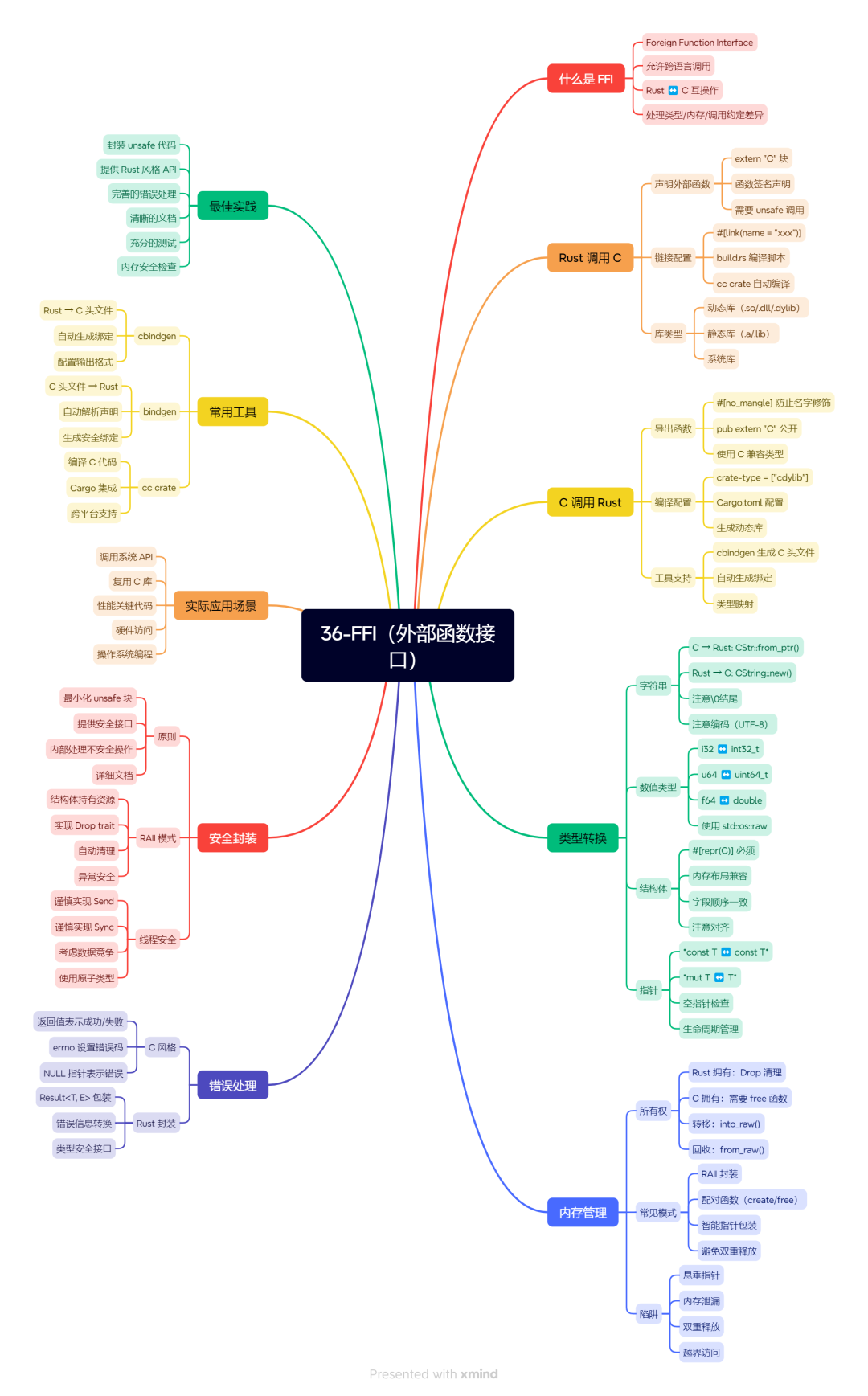
36-FFI(外部函数接口)
📝 小结
- FFI 让 Rust 和 C 可以互操作,但需要处理类型、内存布局、字符串等差异
- Rust 调用 C: 用
extern "C"声明,在unsafe块中调用 - C 调用 Rust: 用
#[no_mangle]和extern "C"导出函数 - 字符串转换: CStr(C→Rust)、CString(Rust→C),注意\0结尾
- 结构体互操作: 必须加
#[repr(C)]保证内存布局兼容 - 内存管理: 谁分配谁释放,或用 RAII 封装
- 安全封装: 将 unsafe 代码封装在安全的 Rust 接口内
金句时间:
FFI 就像两个国家的边境检查——需要翻译、需要手续,但只要手续齐全,通行无阻。
🔗 下篇预告
FFI 学完了,你是不是觉得:"手动写这些绑定太麻烦了!"
确实,如果一个 C 库有几百个函数,难道要一个个手写?
下篇咱们就来聊聊 宏编程,看看怎么用元编程自动生成代码。届时你会看到:
- declarative!宏(macro_rules!)
- procedural macros(过程宏)
- 怎么用宏减少重复代码
敬请期待 第 37 篇:宏编程!
🔗 参考资料
- The Rustonomicon - FFI
- Rust by Example - FFI
- cbindgen - 生成 C 头文件
- bindgen - 从 C 头文件生成 Rust 绑定
本文参与 腾讯云自媒体同步曝光计划,分享自微信公众号。
原始发表:2026-06-01,如有侵权请联系 cloudcommunity@tencent.com 删除
目录
腾讯云开发者

Copyright © 2013 - 2026 Tencent Cloud. All Rights Reserved. 腾讯云 版权所有
深圳市腾讯计算机系统有限公司 ICP备案/许可证号:粤B2-20090059  粤公网安备44030502008569号
腾讯云计算(北京)有限责任公司 京ICP证150476号 | 京ICP备11018762号